
How to Authenticate a Loewe Gate Bag: 9 Checks

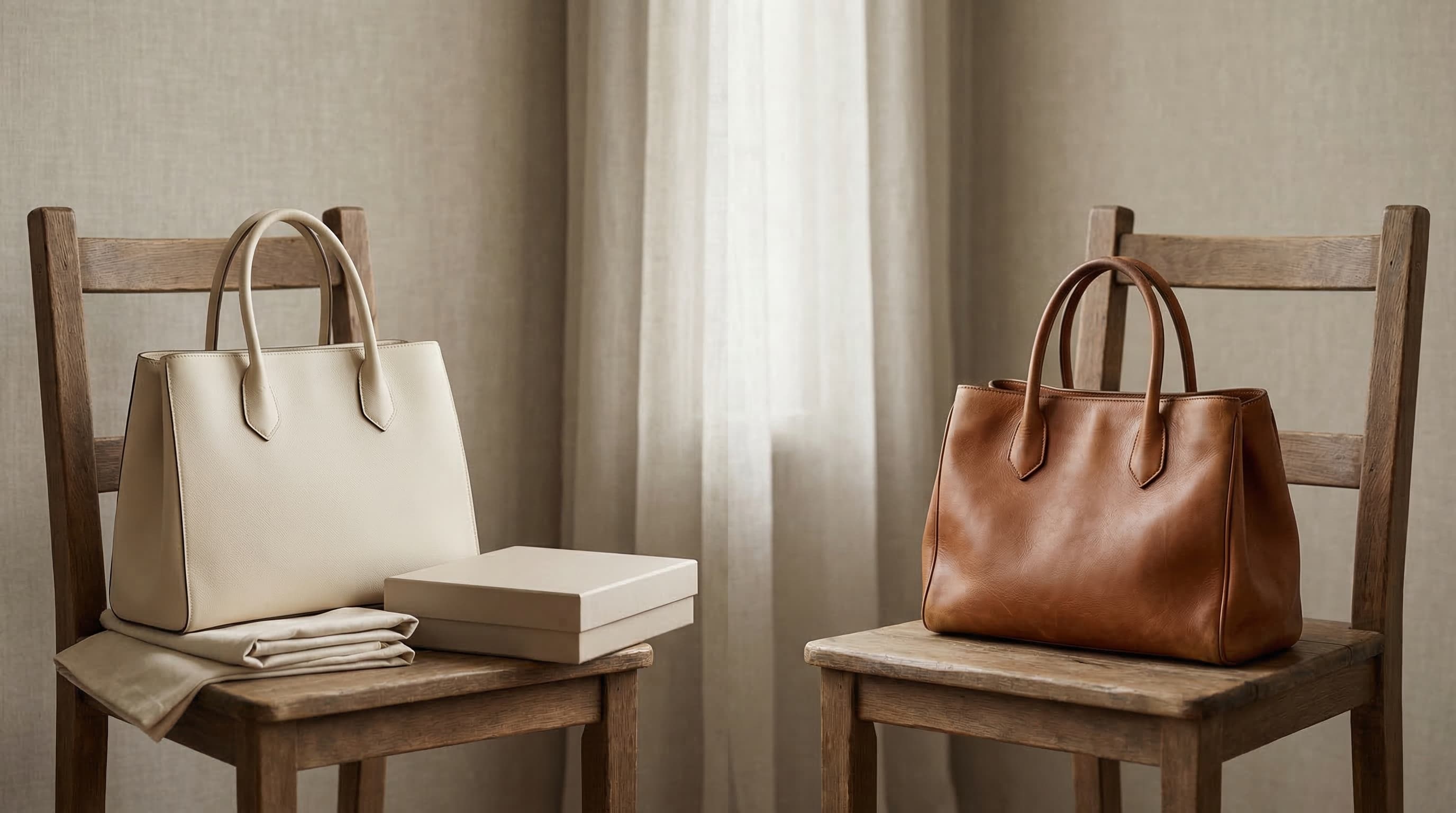
How to Authenticate a Loewe Gate Bag: 9 Checks (2026)
The Loewe Gate is authenticated the way it was designed: as an exercise in leather craft rather than in logos. It is a half-moon saddle crossbody in soft calfskin, closed by a rounded front flap that tucks behind a knotted leather belt, fastened at the side by a polished metal pin with a short leather strip hanging from it, and signed only by a tonal debossed Anagram on the flap. Unveiled at the house's Spring/Summer 2018 runway and kept in the line since, the family has since grown to a large original size, a Small crossbody, Dual and Mini variants, a bumbag and top-handle offshoots, in smooth and soft grained calfskin with bonded suede lining. Because there is no large hardware logo to lean on, copies survive or fail on construction: saddle curvature, knot geometry, pin weight, edge paint, stitch discipline and an interior plan that changes by size. Work the nine checks in order, always against the exact size and version named in the listing — a Dual judged by Small interior rules is a category error before it is an authentication — and let the checks vote together. This guide sits in our wider authentication library: Balenciaga City, Balenciaga Hourglass, Balenciaga Le Cagole, Bottega Veneta Andiamo, Bottega Veneta Cassette, Bottega Veneta Jodie, Bottega Veneta Pouch, Bottega Veneta Sardine Bag, Cartier Love Bracelet, Celine Belt Bag, Celine Luggage, Celine Triomphe, Chanel 19, Chanel 2 55 Reissue, Chanel Boy Bag, Chanel Classic Flap, Chanel Coco Handle, Chanel Gabrielle, Chanel Wallet On Chain, Dior 30 Montaigne, Dior Bobby, Dior Book Tote, Dior Caro, Dior Lady Dior, Dior Saddle Bag, Fendi Baguette, Fendi Peekaboo, Givenchy Antigona, Goyard Saint Louis, Gucci Bamboo 1947, Gucci Dionysus, Gucci Horsebit 1955, Gucci Jackie 1961, Gucci Marmont, Gucci Ophidia, Hermes Birkin, Hermes Bolide, Hermes Constance, Hermes Evelyne, Hermes Garden Party, Hermes Kelly, Hermes Lindy, Hermes Picotin Lock, Jacquemus Le Bambino, Jacquemus Le Chiquito, Loewe Flamenco, Loewe Gate Bag, Loewe Hammock Bag, Loewe Puzzle Bag, Louis Vuitton Alma, Louis Vuitton Capucines, Louis Vuitton Keepall, Louis Vuitton Multi Pochette, Louis Vuitton Neverfull, Louis Vuitton Onthego, Louis Vuitton Pochette Metis, Louis Vuitton Speedy, Louis Vuitton Twist Bag, Miu Miu Wander Bag, Prada Cleo, Prada Galleria, Prada Re Edition 2005, Saint Laurent Kate, Saint Laurent Le 5 A 7, Saint Laurent Lou Camera Bag, Saint Laurent Loulou, Saint Laurent Manhattan, Saint Laurent Sac de Jour.
Quick note: no single check proves a bag is real. Weigh all nine together, and always against the exact size, leather and strap version the bag claims to be.
Short answer
A genuine Gate belongs to Loewe and has been the house's knotted saddle crossbody since its Spring/Summer 2018 debut, named for the side-latched metal pin with its dangling leather strip and the knotted front belt the flap tucks behind. The original size measures about 27 × 26 × 15 cm, the Small about 20 × 19 × 11.5 cm and the Mini Dual about 21 × 12 × 8–9.5 cm — every figure approximate because houses order their axes differently and soft calfskin relaxes in carry. Interiors are bonded suede with a dividing slot or paired compartments and a large rear slit pocket, the strap adjusts with cufflink-style studs, and the serial is debossed into leather with no public Loewe lookup behind it. Price is never a check.
1. Model, Era and Size Class
Fix what the bag claims to be before scoring anything else, because Gate today names nearly a decade of production, at least three size classes and several spin-off formats, and sellers routinely list a Dual or a bumbag under a plain Gate title. The house boundary is consistent across its own product copy and retail histories: the Gate was first shown at the Spring/Summer 2018 runway under Jonathan Anderson, took its name from the side-latched metallic pin and knotted front belt, and was scaled down into a Mini later in 2018 before Dual, bumbag and top-handle versions followed. A claimed Gate dated before that debut, or a flap bag whose closure is a turn-lock rather than a tucked flap and knot, is background that needs evidence rather than a starting point.
Measure the empty bag with the flap closed and the body unstuffed: width across the base, height from base to the top of the saddle curve, then depth at the widest gusset. The original Gate sits near 27 cm wide, 26 cm high and 15 cm deep; the Small crossbody sits near 20 × 19 × 11.5 cm with strap lengths quoted around 106.5–121 cm; the Mini Dual sits near 21 cm wide, 12 cm high and 8–9.5 cm deep. Those ladders explain most measurement arguments: calfskin slouches, and one seller measures over the curve while another measures the base. A centimetre never decides this check. A bag sold as a Small that measures as an original in all three dimensions, or as a Dual that cannot approach the Dual footprint, has a naming problem to resolve first.
Close with version, because the ladder does not share every detail across its life. Early originals carry the large rear slit pocket and dividing slot; Dual versions add a concealed magnetic fastening under the flap and a logo jacquard strap option; bumbag versions trade the crossbody strap for a belt. Style numbers in the 321 family recur across genuine listings, but a style number is a listing aid, not an authentication: fix size class, leather finish, strap system and lining first, then apply the remaining eight checks inside that format.
2. Saddle Silhouette, Panel Work and Leather
Set the empty bag down and read the construction before touching the hardware. Across the family the genuine body is a half-moon saddle: a curved top line falling to a structured flat base, two main faces joined by side gussets, and a rounded front flap whose lower edge disappears behind the knotted belt. The body should hold that curve empty, flex without collapsing at the gussets, and sit level on its base. Retailer descriptions return to the same vocabulary — saddle-shaped, front flap, knotted belt — because it follows from the pattern, not from decoration. Copies drift predictably: a curve that only exists when the bag is stuffed for photographs, gussets so stiff the body stands like a box, or a flap cut as a flat rectangle that cannot tuck and still lie smooth.
Then judge the leather the version claims. The core family is cut in soft calfskin — smooth on early originals, soft grained on most later Small and Dual versions — with trim, belt and dangling strip sharing the body's leather family and colour story. Press the body between flat palms: genuine Loewe calfskin feels substantial and dry, flexes with resistance and recovers without the squeak, tack or foam bounce of coated fabric. Grain on grained versions should be a natural, varied pebble rather than a stamped repeat that tiles identically across panels. Seasonal raffia, jacquard and woven versions exist and are judged by their own material logic; a synthetic shine or relief that flattens at the folds on a bag claiming core calfskin fails the agreement however neat the stitching looks.
Finish with the edges, because this house treats them as a signature. Genuine Gate edges are hand-painted — black lacquered edging recurs across listings — laid evenly over flap, belt, strip and base with no raw fibre, bubbling or colour wandering onto the face. Edge paint that cracks white at the first flex point, or a flap edge left raw where the version paints it, is a construction finding that follows the bag into Check 8.
3. Knotted Belt, Front Flap and Side Pin
Find the closure set where the design puts it, because on a Gate the closure is the identity. The front flap pulls in under a knotted leather belt that wraps the body: you do not untie anything to open the bag — you lift the flap, and the knot and belt hold their geometry whether the bag is open or closed. Work the knot by hand. The belt should be a continuous leather strap of even width, knotted once with clean folds, its ends finished and painted like the body, and the flap should slide behind it without forcing or gaping. A knot that is glued decoration on a flap that actually closes with a hidden snap — outside the Dual versions that genuinely add a concealed magnet — is a disagreement to resolve, not a shortcut to excuse.
Read the pin next, on the side where the belt latches. The bag takes its name from this fitting: a polished metal pin, hinged or latched at the side, with a short leather strip dangling from it. The pin should feel solid rather than hollow, its polish even, its hinge action firm without wobble, and the strip should match the body's leather, hang cleanly and show the same edge paint and stitch discipline as the belt. Retailer copy repeats the same set — side pin, dangling strip, knotted belt — across sizes because the trio is one mechanism. Copies lose this check with a pin that is a surface appliqué, a strip in a borrowed leather, or hardware tones that change between pin, studs and strap fittings on the same bag.
Era matters here as much as anywhere. Dual versions pair the knot with a concealed magnetic fastening and often a wider jacquard strap; bumbag versions move the same knot logic onto a belt body; top-handle versions keep the pin but change the carry. Score the version in front of you against its own format, and remember that a correct knot on a bag whose leather, lining and stitching have already failed never rescues the bag.
4. Debossed Anagram and Stamp Discipline
Find the house mark where the version puts it. On the Gate the Anagram — Loewe's four-L motif — is debossed, pressed into the leather of the front flap, usually low and tonal, with later listings describing it as embossed to tone so it reads by shadow rather than by colour. Read it straight on and then at an angle. The motif should sit symmetric, its four arms balanced, the impression crisp at the edges and even in depth, centred on the flap's axis rather than drifting toward a seam. Because the mark is debossed, it should still be there under raking light and should never be a surface print that sits on top of the grain.
Then read the stamp as leatherwork. A genuine impression is pressed with heat and pressure into calfskin, so the grain inside the mark is compressed smooth while the surrounding pebble survives; a printed or foil copy sits on the surface, fills with colour, or shows doubled edges where a stamp was struck twice. House authentication guidance across Loewe models returns to the same point: markings are physically debossed, never painted on. An Anagram that wipes, flakes or reads only when the light is flat is a finding.
Close with placement agreement. Seasonal versions move or resize the mark, and some Mini formats carry the stamp at a front corner rather than dead centre; what cannot change is the discipline — one mark, symmetric letterforms, depth that agrees with the flap's other impressions, and no second logo competing with it. A correct Anagram on the wrong panel for the version, or a crisp mark on a bag whose knot and pin have failed, supports nothing by itself.
5. Shoulder Strap, Cufflink Adjustment and Carry Logic
Work the carry system against the size fixed in Check 1, because the Gate does not have one universal strap. The original and Small crossbody versions carry an adjustable leather shoulder strap fastened with cufflink-style studs — the strap buttons through punched holes onto metal studs rather than sliding through a buckle — with genuine listings quoting strap lengths roughly in the 99–121 cm band depending on size and season. Dual versions add an adjustable, detachable logo-jacquard webbing strap as an alternative carry; bumbag versions replace the strap with a belt. Handle the leather strap: it should feel substantial, hold its holes without stretching into ovals, and show stitching and edge paint at the body's standard.
Score the attachments. Studs should seat with a positive click of metal through leather, sit symmetrically, and share one metal tone family with the side pin; holes should be punched cleanly on-centre, evenly spaced, and unworn into slits on a bag claimed new. Wear should agree with the body: a strap darkened at the grip and creased at the used holes is honest carry, while a supposedly used bag with a plastic-perfect strap and worn corners describes substituted parts. Copies lose this check with buckle adjustment borrowed from another model, jacquard webbing on a version that never carried it, or studs that wobble in oversized holes.
Close with completeness. A crossbody Gate sold without its strap, or a Dual sold with neither strap option, is judged as incomplete rather than passed as another version; a borrowed strap in the wrong leather family is substituted, not original. The check is version agreement throughout: strap type, adjustment logic, leather family, hardware tone and attachment geometry must describe the same bag as Checks 1 to 4.
6. Interior Plan, Suede Lining and Pocket Logic
Open the bag fully and read the plan, because the Gate interior is size-specific and copies routinely replace it with a generic sack. The original and Small crossbody versions are lined in bonded suede and organised with interior compartments split by a dividing slot, plus a large slit pocket at the back; house and retailer listings repeat that divided plan across the core calfskin versions. Dual versions simplify to one main compartment with an internal slip pocket; Mini shoulder formats carry paired internal slip pockets. Inventory what you find against the named size: a Small claiming a single empty cavity, or a Dual claiming the divided three-part plan, is a point to resolve before scoring anything else.
Then name the lining before judging it. The core versions are bonded suede — the lining leather is bonded directly to the structure, so it should sit smooth, move with the body and show no tenting, bubbling or glue ridges at the pocket frames; house copy names bonded suede lining across the calfskin family, sometimes in a contrasting gold tone. A shiny synthetic lining on a version that never used one, or loose fabric hiding the base construction, is an agreement failure. The interior Anagram or LOEWE stamp, where the version carries one, should be debossed with the same discipline as the flap mark in Check 4.
Finish with the small furniture. Pocket stitching should be finer than the exterior work, the dividing slot should stand straight rather than leaning, and the rear slit pocket should sit flat without distorting the saddle curve. Dust bag, care cards and receipts travel separately from bags and can be paired with anything; packaging supports a bag that already passes the nine checks and never carries a verdict.
7. Interior Tag, Debossed Serial and Origin Agreement
Find the interior identification where the version puts it, because on a Loewe the tag and its number are one system. Genuine Gate interiors carry a small leather tag or a directly debossed panel inside a compartment or pocket, stamped with the LOEWE wordmark, Made in Spain and a serial number; placement varies by model and generation, so check pocket interiors and behind the dividing slot with good light before concluding anything is missing. The stamp form is consistent: serif LOEWE lettering, the origin line beneath, and the number pressed into the leather in the same operation.
Read the number by touch as much as by eye. Loewe serials are debossed — physically pressed into the leather — never surface-printed or painted, and a number you can feel with a fingertip is the baseline expectation; a number that sits on top of the surface fails regardless of what its digits say. Public knowledge of the format is deliberately thin: the house publishes no decoding key, the third and fourth digits are generally read as the production year, and the same number can legitimately appear on sister bags from the same year and workshop, so a repeated number is not by itself a fake signal and a unique-looking one is not proof. The honest reading is agreement: digits centred, cleanly impressed, evenly spaced, and consistent with the era the construction claims.
Close with the boundary every Loewe check shares. The house offers no public online verification tool or consumer authentication lookup, and any website claiming to check a Loewe serial is not the house. Spain origin, debossed tag, stamp typography and number format must describe the same bag in the same period as Checks 1 to 6; a correct-format number inside a bag whose leather, knot and stitching fail is a copied number, not a rescue.
8. Stitching, Seams and Edge Finishing
Slow down at the seams, because stitching is where a craft-led bag either holds its standard or gives itself away panel by panel. Across the Gate the exterior work is saddle-stitched in appearance: even-length, even-tension stitches in tonal or deliberately contrasting thread — cream topstitching on darker leathers recurs across genuine listings — running in a single disciplined row along flap, belt, gussets and strap. Read the runs in sequence rather than sampling one corner: the two faces should repeat the same interval, the knot folds should be secured without visible glue, and interior pocket stitching should be finer and subtler than the exterior work.
Then read the finishing. Hand-painted edges, scored in Check 2, should survive here as one system: flap edge, belt edge, dangling strip, strap and base all carrying the same paint discipline, with corners holding their finish where the bag meets surfaces. Copies lose this check with stitches that change length between the two faces of the same bag, loose or doubled rows where the version uses one, thread fraying at the stud holes, or edge paint that changes colour halfway around the flap. Honest wear is different: paint thins at the base corners, suede nap flattens where hands reach in, a stitch scuffs where the bag is set down — but the interval discipline survives everywhere the bag has not been repaired. A restitched strap attachment is a disclosed repair to price; stitching that was never even is a verdict.
Finish with the gussets and base as stitching made structural. The saddle curve is held by gusset seams that must flex symmetrically: the bag should open evenly to both sides and return to the same curve. A body that lists to one side, or a base that rocks because one gusset was set deeper than the other, describes copied pattern work even when every visible stitch looks neat.
9. Full-Set Agreement, Origin and the Verdict
Finish by laying the whole set out together, because a Gate is bought as a set and the set has to agree. Body, strap, belt, knot, pin and dangling strip: each piece should match the bag's size class, leather family, hardware tone and generation, and each should show the same stitching and edge standard as the body. Stamp depth should hold one discipline across flap Anagram, interior tag and serial, and the strap's stud holes, stitch runs and edge paint should read as the same workshop work as the faces. Dust bag, care cards and receipts travel separately and can be paired with anything; packaging supports a bag that already passes and never carries a verdict, and a missing strap or lost strip on a carried bag is a completeness and value point rather than proof of either authenticity or its opposite.
Confirm origin as agreement, not as a slogan. The Gate is made in Spain, stated across house listings and repeated on the interior tag as scored in Check 7; that origin line, the debossed number, the stamp typography and the construction era must all point to the same bag. Loewe publishes no public lookup for serials on this model, offers no consumer verification service, and no card or code checkable nowhere can substitute for the nine checks agreeing in hand.
Set the finished judgement out plainly — size class and era, saddle silhouette and leather, knot, flap and pin, debossed Anagram, strap logic, suede interior plan, tag and serial agreement, stitching and edges — weighed together against the exact Gate the listing claims to be, never price and never packaging. When those eight areas describe one bag in one version, the ninth is simply the act of saying so; when they describe several, no single correct detail, however crisp, outvotes the disagreement.
At a glance: genuine vs copy
| Check | Genuine | Copy signals |
|---|---|---|
| Size & era | SS2018 design still in line; original ≈ 27 × 26 × 15, Small ≈ 20 × 19 × 11.5, Mini Dual ≈ 21 × 12 × 8–9.5 cm, varies by version | Size name and measurements disagree; generation details borrowed from another era |
| Silhouette & leather | Half-moon saddle on a flat base; soft calfskin, smooth or soft grained; hand-painted edges | Stuffed-only curve, box-stiff gussets, stamped-repeat grain, raw or cracking edges |
| Knot, flap & pin | Flap tucks behind a working knotted belt; solid side pin with matching leather strip | Glued knot over a borrowed closure, appliqué pin, mixed hardware tones |
| Anagram | Debossed into the flap, symmetric, tonal, crisp under raking light | Surface print, doubled strike, off-axis or colour-filled mark |
| Strap | Leather strap on cufflink studs (Dual also jacquard option); lengths ≈ 99–121 cm by size | Buckle borrowed from another model, wobbling studs, substituted strap family |
| Interior | Bonded suede; dividing slot plus large rear slit pocket (Dual: single compartment, slip pocket) | Generic sack, synthetic lining, leaning divider, version-wrong pocket plan |
| Serial & tag | Debossed leather tag: LOEWE, Made in Spain, pressed-in number; no public lookup exists | Surface-printed number, loose paper identity, impossible era agreement |
| Stitching & edges | Even single-row saddle runs, finer interior work, one edge-paint discipline throughout | Changing stitch length, doubled rows, fraying at stud holes, half-changed edge paint |
FAQ
When was the Loewe Gate Bag introduced? The Gate was first shown at Loewe's Spring/Summer 2018 runway under Jonathan Anderson and has remained in the line since, growing from the original saddle crossbody into Small, Dual, Mini, bumbag and top-handle formats while keeping the knotted belt and side pin.
What sizes does the Gate Bag come in? The original Gate measures about 27 × 26 × 15 cm, the Small crossbody about 20 × 19 × 11.5 cm and the Mini Dual about 21 × 12 × 8–9.5 cm. Carried bags relax and sellers measure the curve differently, so judge the actual bag's three dimensions against the named size rather than trusting the title alone.
Do I need to untie the knot to open a Gate Bag? No. The front flap simply lifts and tucks back behind the knotted belt; the knot is a working part of the closure geometry, not a tie you undo. Dual versions add a concealed magnetic fastening under the same flap, and a claimed crossbody Gate that only opens by untying a knot should be checked carefully against its version.
Where is the serial number, and can it be looked up? Look for a small leather tag or debossed panel inside a compartment or pocket, stamped LOEWE, Made in Spain, with the number pressed into the leather — never printed on the surface. Loewe publishes no decoding key and offers no public lookup or consumer verification service; the third and fourth digits are generally read as the production year, and the number only supports a bag whose other eight checks already agree.
Why does price not settle authenticity on the Gate? Price is never a check on this model: genuine bags change hands at every price level according to size, condition and completeness, and copies are routinely listed at convincing prices, so the verdict is always the nine checks agreeing — size, saddle, knot and pin, Anagram, strap, interior, serial, stitching and origin describing one bag — never the number in the listing.
Sources
- Sekhon Family Office — Loewe Adds the Bumbag to Its Popular Gate Collection (SS2018 runway debut, side-latched pin naming)
- 2Luxury2 — Loewe Gate Bag Pop-Up (SS2018 unveiling, three sizes, brass hinge pin)
- Bragmybag — Loewe Gate Bag (saddle design, knotted belt, dividing slot interior, original 27 × 26 × 15 cm)
- Liberty — Loewe Small Gate Leather Cross-Body Bag (Small 20 × 19 × 11.5 cm, bonded suede, side pin)
- Reversible — Loewe Small Gate Bag in Soft Grained Calfskin 321.12.T20 (house details, strap 106.5–121 cm, Made in Spain)
- FARFETCH — LOEWE Mini Gate Dual Leather Crossbody Bag (Dual 21 × 12 cm, concealed magnet, suede lining)
- FashioNica — How to Tell If a Loewe Bag Is Real (debossed serial, no public decoding, no Loewe verification tool)
- Libas Collective — Loewe Serial Number & Date Code Explained (debossed never printed, third/fourth digits read as year)