
How to Authenticate a Loewe Hammock Bag: 9 Checks

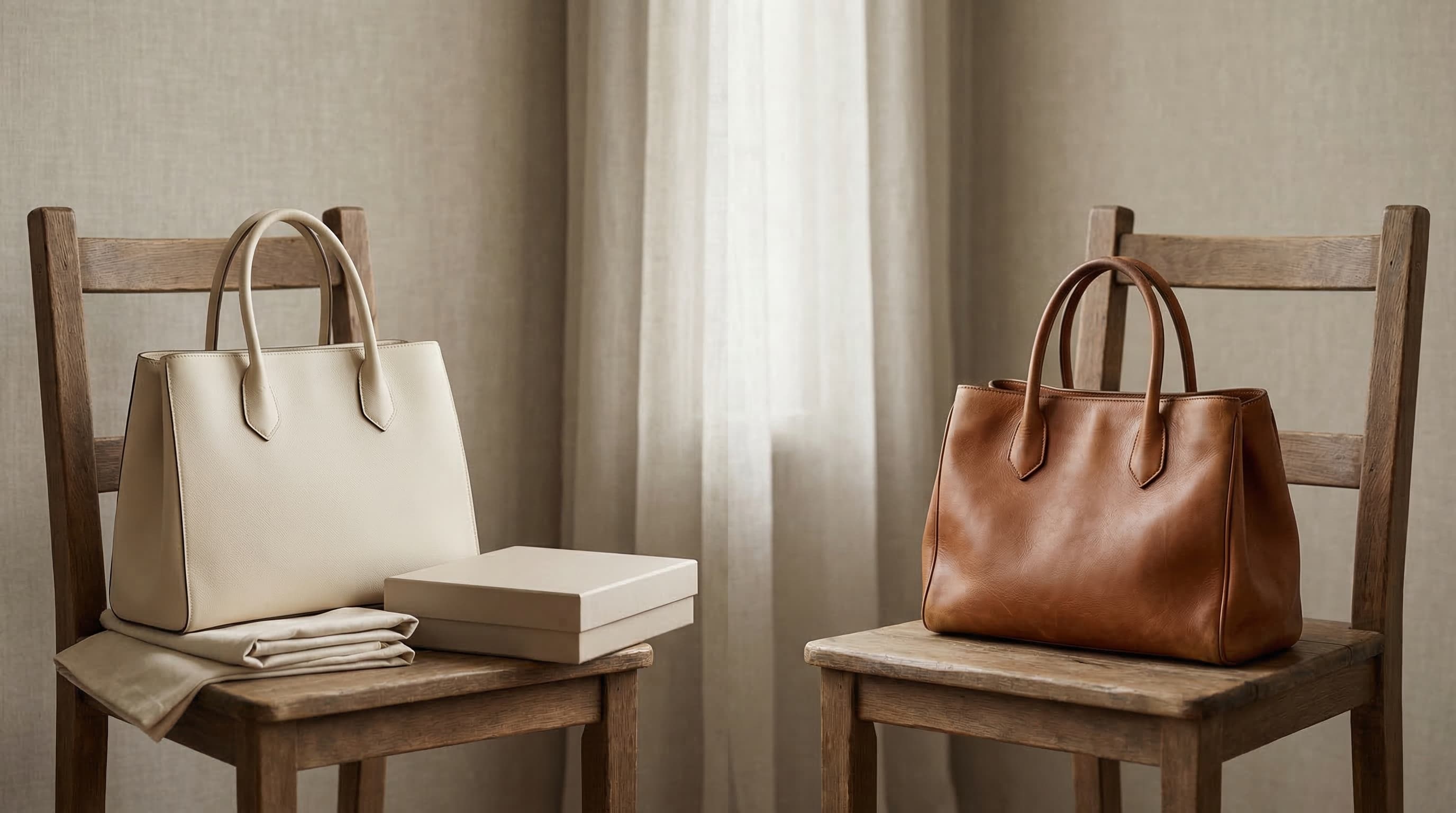
How to Authenticate a Loewe Hammock Bag: 9 Checks (2026)
The Loewe Hammock is easy to photograph and hard to copy well, because its identity lives in movement rather than in a logo. It is a trapeze-shaped bag whose supple side panels release through zips — or, on the later drawstring versions, through cords — so that one body can sit as a compact shoulder bag, open into a winged tote, or fold toward a narrower handheld form, all hung from looped straps that give the design its suspended, hammock-like read. Launched for Spring/Summer 2016 under creative director Jonathan Anderson and kept in the house line since, the model has been made most often in classic calfskin and soft grained calfskin, with satin calf, nappa and Anagram jacquard canvas versions named as variants rather than as substitutes for the core construction. A copy can borrow the outline and still separate when the size class, transformation, leather hand, strap hardware, hook logic, Anagram depth, interior code and herringbone plan each describe a different bag. Work the nine checks in order, always against the exact size, side system and leather named in the listing — a drawstring Mini judged by zip-sided Small rules, or a Compact judged by Medium dimensions, is a category error before it is an authentication — and let the checks vote together rather than letting any one detail decide alone. This guide sits in our wider authentication library: Balenciaga City, Balenciaga Hourglass, Balenciaga Le Cagole, Bottega Veneta Andiamo, Bottega Veneta Cassette, Bottega Veneta Jodie, Bottega Veneta Pouch, Cartier Love Bracelet, Celine Belt Bag, Celine Luggage, Celine Triomphe, Chanel 19, Chanel 2 55 Reissue, Chanel Boy Bag, Chanel Classic Flap, Chanel Coco Handle, Chanel Gabrielle, Chanel Wallet On Chain, Dior 30 Montaigne, Dior Bobby, Dior Book Tote, Dior Caro, Dior Lady Dior, Dior Saddle Bag, Fendi Baguette, Fendi Peekaboo, Givenchy Antigona, Goyard Saint Louis, Gucci Bamboo 1947, Gucci Dionysus, Gucci Horsebit 1955, Gucci Jackie 1961, Gucci Marmont, Gucci Ophidia, Hermes Birkin, Hermes Bolide, Hermes Constance, Hermes Evelyne, Hermes Garden Party, Hermes Kelly, Hermes Lindy, Hermes Picotin Lock, Jacquemus Le Chiquito, Jacquemus Le Bambino, Loewe Flamenco, Loewe Hammock Bag, Loewe Puzzle Bag, Louis Vuitton Alma, Louis Vuitton Capucines, Louis Vuitton Keepall, Louis Vuitton Multi Pochette, Louis Vuitton Neverfull, Louis Vuitton Onthego, Louis Vuitton Pochette Metis, Louis Vuitton Speedy, Louis Vuitton Twist Bag, Miu Miu Wander Bag, Prada Cleo, Prada Galleria, Prada Re Edition 2005, Saint Laurent Kate, Saint Laurent Le 5 A 7, Saint Laurent Loulou, Saint Laurent Manhattan, Saint Laurent Sac de Jour.
Quick note: no single check proves a bag is real. Weigh all nine together, and always against the exact size, side system, leather and strap version the bag claims to be.
Short answer
A genuine Hammock belongs to Loewe and has been the house's transformable trapeze since its Spring/Summer 2016 debut under creative director Jonathan Anderson, the name taken from the hanging-bed construction the suspended straps and released sides recall. Expect a trapeze body with a more structured central panel, supple side panels that release through side zips — or drawstring sides on the Mini and Small versions that carry them — twin top handles plus a detachable adjustable strap for shoulder, crossbody or top-handle carry, an interior hook closure rather than a flap, an external zip pocket with two internal slip pockets on the core sizes, an embossed or debossed Anagram on the central panel, and a herringbone cotton canvas lining. The current ladder runs Mini, Compact and Small from smallest to largest, with a larger Medium in earlier and secondary listings, every figure approximate because side state, leather and measuring method move the numbers. Loewe publishes no public serial lookup for this bag, its interior code is a debossed production code rather than a verifiable unique serial, and price is never a check.
1. Model, Era and Size Class
Begin by fixing what the bag claims to be, because Hammock today names nearly a decade of production, three current size names that retailers do not always use the same way, and two side systems with different authentication rules. Editorial histories and retailer records agree on the boundary: the design was introduced in the Spring/Summer 2016 collection under Jonathan Anderson, taking its name and its construction idea from a hammock — a suspended, flexible support that adapts to what it holds — and it has remained in the line since. The later drawstring versions belong to that same family but change the side mechanism and often the size class, so they must be fixed as their own version before any zip-based check is applied. A seller history that dates the Hammock before 2016, or that treats any soft trapeze tote as a Hammock regardless of side construction, is background that needs evidence rather than a starting point. Judge the bag in hand by size class and construction first, and let any claimed season support a conclusion the construction has already reached.
Then measure the empty bag in a stated side state: width across the widest body point, height from base to top edge not counting the handles, then depth across the side panel. In the commonly published ladder the Mini sits near 18 cm wide, 17 cm high and 9.5 cm deep with the sides drawn in; the Compact near 19.5 cm wide, 20.8 cm high and 14.4 cm deep; and the Small near 30 cm through its longest body axis, 25 cm high and 13.5 cm deep — with the larger Medium in older listings nearer 33 cm wide, 27 cm high and 15 cm deep. Those figures explain why secondary listings disagree by centimetres: retailers publish height, width and depth in different orders, soft calfskin relaxes, and a Hammock measured with its sides released is a wider bag than the same Hammock zipped or drawn closed. A single centimetre never decides this check. A bag sold as a Compact that measures as a Mini in every dimension, or as a Small that cannot approach the Small footprint in any side state, has a naming problem to resolve before any other check is scored.
Close with generation, because the ladder does not share every detail across its life. Core zip-sided versions carry the transformation of Check 2 and the hook-and-pocket plan of Check 5; drawstring versions replace the side zips with cords and must not be condemned for lacking hardware they never had; Anagram jacquard versions substitute patterned canvas side panels for full-leather sides and are judged as that named variant. Fix the format first — size class, side system, leather finish and hardware tone — then apply the remaining eight checks inside it.
2. Transformable Silhouette, Side Zips and Drawstring Sides
Set the empty bag down and read the architecture before you touch the hardware. Across the family the genuine body is a curved trapeze in front view — narrower and more structured at the central panel, fuller and softer at the sides — because the design hangs its flexible sides from a firmer centre, the way a hammock hangs its bed from its supports. House and retailer descriptions return to that centre-and-sides split because it follows from construction rather than decoration: a comparatively rigid central panel carries the Anagram, while the supple side panels are built to release, fold and re-form. Copies drift in recognisable directions: a body of one uniform stiffness with no centre-versus-side difference, side panels that are decorative wings stitched shut, or a silhouette that only holds its trapeze when stuffed for photographs. Read the zones by hand before you read them by eye: the centre should feel like the bag's spine, and the sides should feel like the part that is meant to move.
Work the transformation itself, because on a Hammock this is the design's signature and its hardest engineering. On zip-sided versions, open and close each side zip through its full run: releasing the zips should visibly relax and widen the silhouette toward its tote form, and closing them should draw the bag back toward its narrower shoulder form, without the panels bunching, twisting or fighting the zip. On drawstring versions, work the cords instead: drawing them in should gather the softer sides evenly, and releasing them should let the body open, with the cord channels taking the strain rather than the leather tearing at the eyelets. Authentication value sits in the smoothness of that change — a genuine Hammock transforms as one connected system of panels, handles and straps, while a copy that merely owns two zips sewn onto a fixed tote has the vocabulary without the grammar. A side zip that moves without changing the shape, cords glued into closed channels, or panels that crease sharply and stay creased are findings, not quirks.
Finish with stance and profile. From the side, the genuine bag shows distinct states — drawn in, released, carried — rather than one frozen outline, and placed empty it should settle into its trapeze without collapsing asymmetrically. Softer examples relax at the sides but keep the central panel and base geometry.
3. Leather and Material Hand
Read the leather before anything else, because on a Hammock the surface is most of the bag. The core versions are cut in calfskin in two named families: classic calfskin with a smoother, more even surface, and soft grained calfskin with a fine relaxed pebble; satin calf, nappa on the smaller drawstring versions, and Anagram jacquard canvas with calfskin trim appear as named variants and must be judged as the version they claim to be. House and retailer descriptions keep to that calfskin boundary across Mini to Small, with the canvas versions always named as canvas rather than passed off as leather. Score the finish you fixed in Check 1, not the finish you expected to find.
Score the panels zone by zone under even light, because the Hammock asks different things of its centre and its sides. On grained versions the pebble should be tight, regular and consistent across the central panel, sides, handles and strap, never printed-looking, exaggerated or changing scale at panel joins. On classic and satin calf versions the surface should be uniform and low-sheen with natural hide character kept subtle; on jacquard versions the woven Anagram repeat should sit in register and hold its pattern through the side folds rather than dissolving at them. Press the body between flat palms: genuine calfskin feels substantial and supple, flexing with resistance and recovering without the squeak, tack or foam bounce of coated fabric. Authentication comparisons for Loewe leatherwork return repeatedly to material substitution because copies use thinner, peel-prone leather that creases white, tears at stitch holes or flashes with a plastic shine under light. Any of those behaviours, on centre or sides, is a finding that supports the other checks rather than a matter of taste.
Then match the material story to the version. Central panel, side panels, handles, strap and trim should share the body's material family and colour story, with the hand-painted edge colour held constant across the set; a grained body with a smooth central panel borrowed from another version, jacquard sides on a bag sold as full leather, or a strap in a visibly different dye lot sold as original is an agreement failure. Smell and weight are supporting votes only: genuine calfskin smells of leather without harsh chemical notes, and the larger sizes carry real weight from leather and hardware, but neither rescues failed grain, weave or panel agreement.
4. Twin Handles, Looped Straps and Carry Hardware
Read the carry system as a set, because the Hammock's handles and straps are what suspend the body and copies routinely improvise both. Every core size in the ladder carries twin leather top handles and a detachable, adjustable shoulder strap, the looped strap arrangement letting the bag be worn on the shoulder, worn crossbody, or carried by the top handles, with the smaller Mini leaning crossbody and the larger Small leaning shoulder and hand carry. Retailer specifications for the family keep handle drop near 10 cm on the Compact and Small, shorter on the Mini, and strap length following size — roughly 78 to 85 cm on the Compact and roughly 90 to 105 cm on the Small, every figure approximate. Judge drop against the named size, not against a universal number: a Mini offered with tote-strap claims, or a Small whose strap cannot reach the Small range in any adjustment, describes either a wrong-size listing or substituted parts.
Work the handles first. The twin top handles are flat to lightly padded, symmetrical as a pair, and attached cleanly to the body so that the bag hangs level rather than twisting toward one handle. Handle stitching on a genuine bag is neat and mirrored between the pair, and the handles share the body's leather family and edge-paint story. Handles that lean, attach at mismatched heights, differ visibly from each other in width or grain, or twist the body when the bag is lifted by them are findings, while honest darkening where hands grip and creasing at the attachment flex points are carry wear that leaves construction intact.
Then work the strap and its fittings. The detachable strap should be in the body's leather family where the version is a leather strap — some versions carry a named jacquard or customisable strap variant, judged as that variant — its stitching tight, even and tonal, its adjustment holes or slider cleanly finished. The strap fittings and the looped attachment points are small engineering: they should move and seat with a positive, finished action, their metal smooth and evenly finished in the version's tone, palladium on many core versions and gold on others, held constant across hook, zips and fittings. Fittings that are feather-light, rough at the edges, mismatched in tone from the side zips, or attached so the strap twists the body rather than suspending it are findings; a replaced strap in the wrong material is a completeness point to disclose and price, not a rescue for failed hardware.
5. Hook Closure, Side Zips as Hardware and Pocket Logic
Work the closures in the order the design intends them, because the Hammock separates its jobs and copies routinely merge them. The top of the core bag is open rather than flapped, secured inside by a single interior hook closure that draws the mouth together; the side zips of Check 2 are shape hardware, not access closures, and must not be scored as if they were the bag's opening. Score the bag against its named version: a core zip-sided bag whose mouth has no working hook at all, or whose only closure is a magnet or snap borrowed from another design, has a version problem to resolve before finish is discussed. The hook should engage positively without forcing, hold the top closed against the central panel, and release without tearing at its stitching or distorting its seat.
Then read the zips as hardware, not as decoration. The side zips should run their full length smoothly in both directions without catching, their teeth straight, even and fully interlocking along the run, and the external zip pocket — present on the core Compact and Small — should meet the same teeth, slider and puller standard. The slider and puller should feel solid with cleanly finished edges, proportioned to the bag, in the version's metal tone. Authentication guidance for transformable bags treats zip behaviour and transformation together for a reason: a zip that judders, separates behind the slider, or runs over crooked teeth will also fail to draw the side panels evenly, so a closure finding here usually reappears as a silhouette finding in Check 2. A zipper that is present as trim but sewn into a closed channel, fabric tape whose stitching wanders, or pullers in a different metal tone from the hook and strap fittings belongs here as much as to Check 8.
Close with pocket presence as size logic. On the core versions the plan is consistent: one external zip pocket and two internal slip pockets inside a single main compartment, with the Anagram jacquard Small described in some listings with a single internal slip pocket as its named variant. Judge presence and absence against the named size and variant fixed in Check 1, and judge any zip that is present by the standard above. An external pocket added to a version that never carries one, missing from a version that always does, or a pocket set borrowed wholesale from another size inside a smaller body is an agreement failure, not a variant.
6. Anagram, LOEWE Wordmark and Stamp Discipline
Find the house marks where the version puts them, and read them as form before you read them as logos. On the Hammock the public mark is the Anagram — Loewe's four-L device — embossed or debossed into the rigid central panel, discreet against the leather rather than applied as a plaque on the core versions, with the LOEWE wordmark carried inside on the leather tag or debossed interior logo. Authentication guidance for Loewe stamping returns to a small set of behaviours that copies reproduce badly: the Anagram should be perfectly symmetrical, its depth even across the device, its edges clean where the stamp meets the grain, sitting centred to the central panel rather than drifting toward a seam. Read the mark straight on under even light. An Anagram that leans, stretches wider on one side, sits visibly off-axis, or shows one arm pressed deeper than the rest is already arguing against the bag.
Then read depth against material, because the stamp must belong to the leather it sits in. On grained calfskin the device should hold its definition through the pebble without either floating on the surface as print or punching so deep that the grain tears around the arms; on classic and satin calf it should read as a clean, even impression with the same symmetry. A surface-printed Anagram that can be felt as ink rather than impression, a foil or paint fill the version never carries, or lettering whose edges bleed on smooth leather belongs to the same finding. The interior wordmark shares that discipline: clean debossed lettering, even weight, with the Made in Spain origin line in the same typographic voice, embossed into leather rather than printed on it.
Finish with placement agreement. The exterior Anagram, the interior LOEWE stamp, the origin line and the code tag of Check 7 form one labelling system and should describe one bag made in one place: a central-panel Anagram borrowed from the jacquard versions rendered as an all-over repeat on a bag sold as plain calfskin, an interior stamp in a different voice from the tag beside it, or a Made in Spain line on a bag whose construction claims another origin is an agreement failure. The stamp supports a bag whose construction passes; it never rescues one that does not.
7. Interior Code: Format, Placement and Reading
Open the bag and find the interior code where the version puts it, because on a Loewe bag this code is a dating tool, not a unique verifiable serial, and must be read as such. House practice, confirmed across independent authentication references, is consistent: Hammock bags carry a short numeric code debossed into leather inside the bag — most often described as six digits, sometimes with letters by version — set on a small interior leather tag or directly on an interior panel or pocket interior, discreetly placed and sometimes tucked under a zip flap or deep in a pocket corner where patience and good light are needed. What matters is placement logic: the code should sit inside the bag where the named size and generation puts it, be physically pressed into the leather rather than displayed on a loose paper card, and never appear as surface print pretending to be the bag's identity. Loewe includes no traditional authenticity-card system for this bag, so the absence of a separate card is expected and proves nothing either way.
Read the format next, because public knowledge of the Loewe code is deliberately partial and the guide must not pretend otherwise. Authentication references agree that Loewe does not publish a decoding key and offers no public online verification tool: the third and fourth digits of the six-digit form are generally read as indicating the production year, and that is as far as public reading reliably goes, with the remaining digits and any maker or workshop meaning not publicly resolvable. Genuine examples hold the format cleanly in a consistent deboss with even spacing and digits pressed to one depth; copies lose this check with surface-printed or painted numbers, invented separators, wavy or bunched characters, or a tag whose stitching and leather visibly belong to a different bag. Because the house keeps the full key unpublished, any seller or listing that offers to resolve a Hammock code to an exact factory and day is claiming a certainty the public record does not support.
Close with the boundary every Loewe check shares: a code alone never authenticates, because a correct-format code is copied as easily as an incorrect one, and its only honest job is agreement. Format, deboss depth, tag placement, Anagram discipline and the Made in Spain origin must all describe the same bag in the same period, and the year implied by the middle digits must be compatible with the version's availability — a drawstring Mini carrying a code that reads well before the drawstring versions exist has an era problem no font can fix. A correct-format code inside a bag whose transformation, leather and stitching fail is a copied code, not a rescue; a bag with no findable code where the version always carries one has a genuine problem to explain.
8. Stitching, Edges, Hardware Finish and Base
Slow down at the seams, because stitching is where a transformable bag either holds its standard or gives itself away panel by panel. Across the Hammock the working thread sits in even rows at consistent length, tension and thickness, with tight execution on central panel joins, side-panel seams, handle attachments, strap work and interior pocket work alike — some versions carrying deliberate contrast stitching, which must then be consistent as that version's named choice rather than accidental. Authentication comparisons for Loewe leatherwork return to the same discipline from several directions: stitches even and tight on a genuine bag, loose, wandering or unevenly spaced on copies, with thread colour correctly matched to the version rather than a near-miss shade laid over the body. Read those runs in sequence rather than sampling one corner: the two sides of the bag should mirror each other through their transformations, the central panel joins should hold one interval along their full length, and the interior work should be finer and subtler than the exterior seams, never thicker or driven deeper than the work around them.
Then read the edges and hardware together. Leather edges on the central panel, side panels, handles and strap should be cleanly finished with the version's hand-painted edge colour, evenly applied with no peeling, bubbling, raw fibres or glue residue at the flex points where the sides fold and the handles attach. The metal set — interior hook, side-zip sliders and pullers where fitted, external pocket zip and strap fittings — should share the version's tone, palladium on many core versions and gold on others, with smooth, evenly finished surfaces and a solid hand weight. There are no base feet to score on the core Hammock: the bag sits on its base panel, so judge the base by panel evenness, edge paint and wear that agrees with the corners above it rather than by a foot set the design never carried. Missing feet are not a finding on this bag; plastic-feeling fittings, tones that differ from one hardware point to the next, or edge paint in a colour the version never uses are.
Close with honest wear, which is different throughout. Hand-painted edges thin where the sides fold and where hands grip, side-panel leather softens and takes creases from repeated transformation, hardware takes faint scratches at the hook and zip runs — but the interval discipline, edge construction and metal tone survive everywhere the bag has not been repaired. Stitching that was never even is a verdict that supports Check 3 rather than replacing it.
9. Interior Plan, Lining and the Full-Set Verdict
Open the bag fully and read the plan, because the Hammock interior follows version and copies routinely replace it with an undifferentiated sack. The core lining story is herringbone cotton canvas — woven in a cotton and linen blend on the core versions — over a single main compartment reached through the open top and its hook closure, with two internal slip pockets and the external zip pocket of Check 5. Beyond that shared story, the plan must be scored as version logic: the Anagram jacquard Small is described in some listings with a single internal slip pocket, drawstring versions carry their two interior compartments behind the gathered sides, and any suede-interior claim belongs to other Loewe models rather than to the core Hammock and must be evidenced as the named variant it claims to be. Inventory what you find against the named size and variant: pockets padded with wrong stitching, a lining in a material family the version never uses, or a pocket set borrowed from a larger size inside a smaller body are points to resolve, not details to wave through.
Read the lining material itself with the same hand as Check 3. Genuine herringbone canvas is even, dry and closely woven, its chevron pattern regular across the walls and holding its register through the pocket attachments, its colour story agreeing with the exterior version, its seams and pocket work following the interior stitch discipline of Check 8. Copies substitute thin synthetic linings that shine, pill or separate from the walls, print a herringbone pattern onto flat cloth that dissolves under close light, or line a claimed calfskin version in a material no Hammock of that size and era carries. The code tag from Check 7 belongs to this interior system as well: its leather, stitching and placement should belong to the lining around it, not arrive as a later insertion.
Close with the full set, because authentication ends in agreement rather than in any single detail. Line the nine checks up and ask whether they describe one bag: the size class and era of Check 1, the transformation and side system of Check 2, the leather hand of Check 3, the twin-handle, strap and fitting set of Check 4, the hook and pocket logic of Check 5, the Anagram and stamp discipline of Check 6, the interior code format and its implied year in Check 7, the stitching, edges and hardware finish of Check 8, and the interior plan of this check must all point to the same size, the same material story and the same period. The house publishes no public serial lookup for this bag, its code is only partly decodable by design, and price is never a check — a low price proves nothing and a high price rescues nothing. Where the votes split, name the split honestly — right construction with a replaced strap is a disclosure and pricing question, a printed code on otherwise plausible construction is a research question — and where transformation, leather, lettering and code fail together, the verdict has already been reached by the bag itself.
At a glance: genuine vs copy
| Check | Genuine Hammock | Common copy pattern |
|---|---|---|
| Size and era | Mini about 18 × 17 × 9.5 cm drawn in; Compact about 19.5 × 20.8 × 14.4 cm; Small about 30 × 25 × 13.5 cm through longest axis; Medium in older listings about 33 × 27 × 15 cm; family from Spring/Summer 2016 | Sizes off in every dimension, size names swapped between ladders, bag dated before 2016 |
| Transformation | Rigid central panel with supple sides that release through full-run side zips, or gather evenly on drawstring versions, changing the silhouette as one system | Uniform stiffness, zips sewn onto fixed panels that change nothing, cords glued into closed channels |
| Leather | Classic calfskin or soft grained calfskin consistent across centre, sides, handles and strap; satin, nappa and Anagram jacquard only as named variants | Printed or exaggerated grain, plastic shine, thin peel-prone substitute, jacquard sides sold as full leather |
| Handles and strap | Twin top handles hanging level with mirrored attachments; detachable adjustable strap whose length follows size; fittings positive and tone-matched | Leaning or mismatched handles, substituted strap in wrong material, feather-light fittings in mixed tones |
| Hook and pockets | Interior hook closure drawing the open top together; smooth full-run side and external zips; external zip pocket with two internal slip pockets on core versions | No working hook, magnet or snap borrowed from another design, juddering zips, pocket set borrowed from another size |
| Anagram and stamps | Symmetrical Anagram embossed or debossed evenly into the central panel; clean debossed LOEWE and Made in Spain inside | Leaning or unevenly pressed Anagram, surface-printed device, interior stamp in a different voice from its tag |
| Interior code | Short debossed code, commonly six digits, on interior leather tag or pocket interior; middle digits generally read as production year; no public lookup | Surface-printed or painted code, invented separators, loose card offered as identity, code resolved to exact factory and day |
| Stitching and hardware | Even consistent rows mirrored between sides; clean hand-painted edges; one metal tone across hook, zips and fittings; no feet by design | Loose wandering stitching, peeling or wrong-colour edge paint, mixed metal tones, findings claimed for feet the bag never had |
| Interior | Herringbone cotton canvas lining, regular chevron, single main compartment with the version's slip-pocket plan | Shiny synthetic lining, printed herringbone that dissolves under light, generic sack with borrowed pockets |
FAQ
When was the Loewe Hammock introduced, and who designed it? The Hammock was introduced in the Spring/Summer 2016 collection under creative director Jonathan Anderson. Its name and construction come from a hammock: flexible sides suspended from a firmer centre and looped straps, so the body adapts its shape the way a hanging bed adapts to what it holds.
Which Hammock sizes exist, and why do listings disagree? The current ladder runs Mini, Compact and Small from smallest to largest, with a larger Medium in earlier and secondary listings. Published dimensions are approximations: retailers list height, width and depth in different orders, soft calfskin relaxes, and the same bag measures wider with its sides released than zipped or drawn closed. Measure the base, height and depth in a stated side state and judge the bag against its named size.
What is the difference between the zip and drawstring Hammock? They are two side systems in one family. Zip-sided versions release and draw in their side panels through full-run side zips; drawstring versions, including the Mini drawstring bags, gather softer sides through cords instead. A drawstring bag must not be condemned for lacking side zips it never had, and a zip-sided bag must not be passed with decorative zips that change nothing.
How do I read a Loewe Hammock interior code? Core bags carry a short code debossed into interior leather, commonly six digits, on a small tag or pocket interior. Public knowledge is partial by design: the third and fourth digits are generally read as the production year, Loewe publishes no decoding key, and there is no public lookup. A correct-format code supports authentication only when its implied era agrees with the size, side system and construction; a printed rather than debossed code is wrong whatever the digits say.
Can price tell me whether a Hammock is real? No. Price is never an authentication check in this guide. Genuine Hammocks appear at many price points according to size, leather, era and condition, and copies are routinely priced to look plausible. Judge the bag by the nine checks — size and era, transformation, leather, carry hardware, hook and pocket logic, Anagram, interior code, stitching and interior — and let price play no part in the verdict.
Sources
- The Luxury Closet — Loewe Hammock bag, Spring/Summer 2016 introduction
- Luxbags — Swing your style with the Loewe Hammock bag, a size guide
- Luxbags — Cracking the code: finding and understanding your Loewe handbag's serial number
- Libas Collective — Loewe serial number and date code explained (2026)
- FashioNica — How to tell if a Loewe bag is real, full guide
- Liberty London — Loewe Hammock Compact leather bag, details and dimensions
- Liberty London — Loewe Hammock leather bag, central panel and lining details
- David Jones — Loewe Hammock Compact bag in satin calf, specifications
- David Jones — Loewe Hammock DW Mini bag in classic calf, specifications
- FARFETCH — LOEWE compact Hammock bag in classic calfskin, highlights and measurements