
How to Authenticate a Gucci Bamboo 1947 Bag: 9 Checks

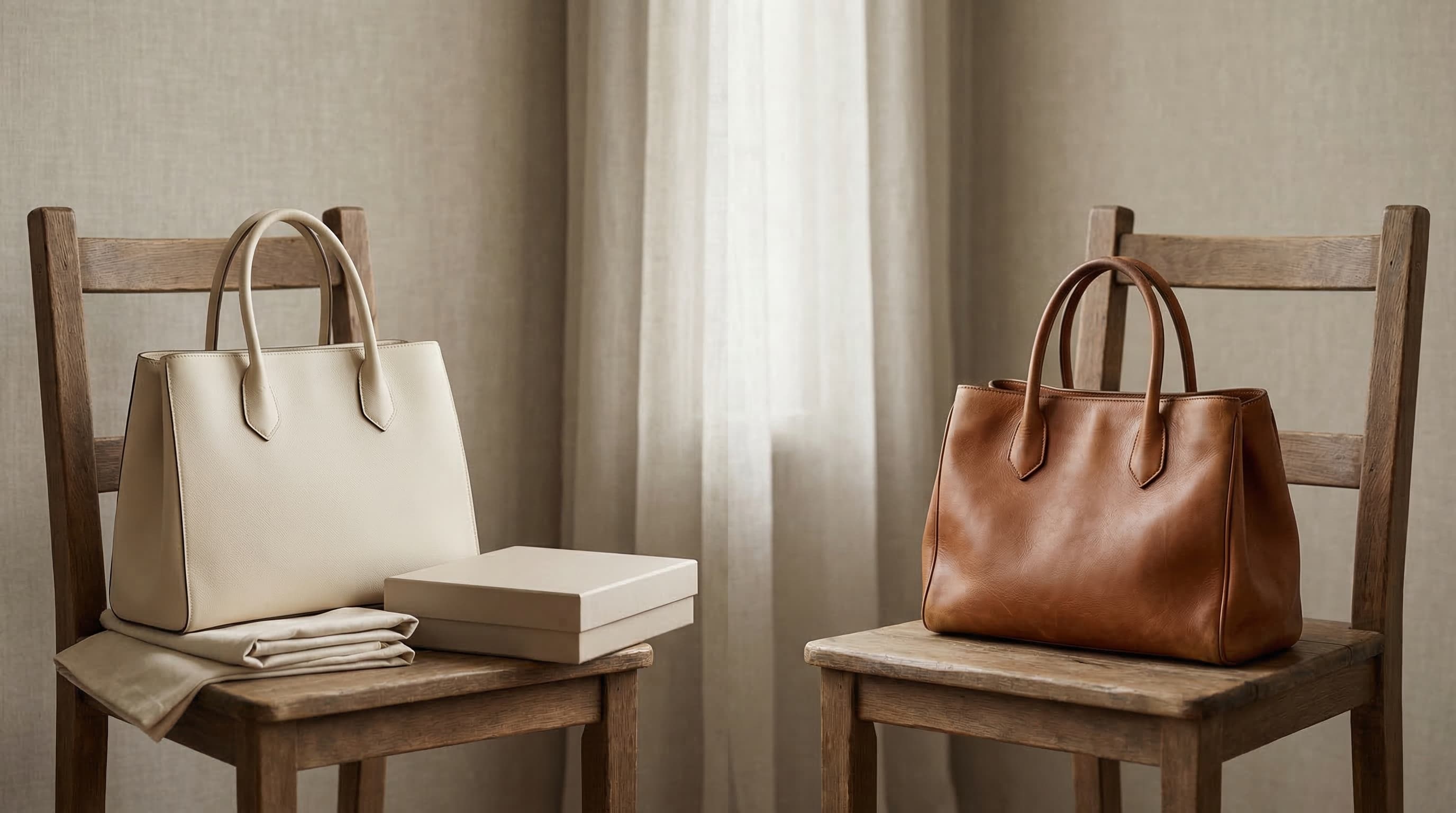
How to Authenticate a Gucci Bamboo 1947 Bag: 9 Checks (2026)
The Gucci Bamboo 1947 is a structured top-handle bag whose identity is carried less by a logo than by a material decision made under constraint: a curved bamboo stalk used as both handle and closure furniture over a disciplined, saddle-leaning flap body. A copy can copy the photograph — pale curved handle, front flap, gold-toned fittings — and still separate on agreement, because the size class, the handle arc and its nodes, the turn-lock action, the panel material, the stitching, the interior leather tab, the black fabric label and the hardware engraving each have to belong to the same bag, from the same period, in the same version. Work the nine checks in order, always against the exact size and material the bag claims to be — smooth leather, grained leather and GG Supreme canvas versions do not share every finish or lining — and let the checks vote together rather than letting any one detail decide alone. This guide sits in our wider authentication library: Balenciaga City, Balenciaga Hourglass, Balenciaga Le Cagole, Bottega Veneta Cassette, Bottega Veneta Jodie, Bottega Veneta Pouch, Cartier Love Bracelet, Celine Luggage, Celine Triomphe, Chanel 19, Chanel 2 55 Reissue, Chanel Boy Bag, Chanel Classic Flap, Chanel Coco Handle, Chanel Gabrielle, Chanel Wallet On Chain, Dior 30 Montaigne, Dior Bobby, Dior Book Tote, Dior Caro, Dior Lady Dior, Dior Saddle Bag, Fendi Baguette, Fendi Peekaboo, Givenchy Antigona, Goyard Saint Louis, Gucci Bamboo 1947, Gucci Dionysus, Gucci Horsebit 1955, Gucci Jackie 1961, Gucci Marmont, Hermes Birkin, Hermes Bolide, Hermes Constance, Hermes Evelyne, Hermes Garden Party, Hermes Kelly, Hermes Lindy, Hermes Picotin Lock, Jacquemus Le Chiquito, Loewe Flamenco, Loewe Puzzle Bag, Louis Vuitton Alma, Louis Vuitton Capucines, Louis Vuitton Multi Pochette, Louis Vuitton Neverfull, Louis Vuitton Onthego, Louis Vuitton Pochette Metis, Louis Vuitton Speedy, Prada Cleo, Prada Galleria, Prada Re Edition 2005, Saint Laurent Kate, Saint Laurent Le 5 A 7, Saint Laurent Loulou, Saint Laurent Manhattan.
Quick note: no single check proves a bag is real. Weigh all nine together, and always against the exact size, material and strap version the bag claims to be.
Short answer
A genuine Bamboo 1947 is the top-handle flap bag the house first produced in 1947, when post-war shortages made conventional handle materials hard to source and founder Guccio Gucci with Florentine artisans turned to lightweight, durable bamboo. The profile has been reinterpreted since — notably under Tom Ford in the 1990s and in the current revival — but the production logic has stayed: a chosen stalk softened and worked by hand over an open flame into a half-round, then built up with successive lacquer coats and baked to a deep golden-brown gloss, so that no two genuine handles read exactly the same. The current retail ladder, as listed by the house itself, runs from a Mini at about 17 × 12 × 7.5 cm with an 8 cm handle drop to a Small at about 21 × 15 × 7 cm with an 11 cm handle drop, with resale guides adding a Medium at roughly 27 × 18–19 × 9 cm and a Large at roughly 31 × 21 × 9 cm. Retailers measure depth, drop and strap length differently, so judge by size class and proportion and treat every figure as approximate. The bag should hold a structured outline, carry on its bamboo handle with two detachable and adjustable straps — one in leather and one in the green-red-green Web — close with a front flap on a bamboo turn-lock, and show an interior that matches its size: a leather lining with a card holder on the Mini, a cotton-linen lining with a zip pocket and an open pocket with mirror on the Small. Current retail copies give Made in Italy. Asking price is never a check.
1. Model, Era and Size Class
Start by naming what the bag claims to be, because Bamboo 1947 today describes a family that shares a handle and a flap but not a set of dimensions, and because the name itself carries a date that copies borrow without earning. Brand and editorial histories agree on the boundary: the first bag of this type was made in 1947, in the immediate post-war period, when leather and hardware stock were scarce and bamboo offered a strong, light alternative the Florentine workshops could shape by hand. That date is a floor, not a proof. A bag presented as an original 1947 production has to survive a vintage conversation — materials, lining, tab form and number format from that period — while a revival bag presented with a 1947 story and a modern black fabric label has an era problem before it has a craftsmanship discussion. Most bags you will meet are revival pieces, and they should be judged as such: correct for their own production window, not dressed up as wartime originals.
Then measure with the bag empty but closed, base width first, then height, then depth, and compare to the nearest class in the Short answer. Anchor on the house's own figures where you can: the Mini at about 17 cm wide, 12 cm high and 7.5 cm deep, and the Small at about 21 cm wide, 15 cm high and 7 cm deep. Where a resale guide orders the same bag differently — length before height, or with handle drop folded into the total — write the figure as approximate and judge proportion, not the last digit. Sellers use mini and small loosely, so measure rather than trusting the listing title: a bag sold as a Mini that measures like the Small, or a Medium whose height belongs to the Small, has a naming problem to resolve before any other check is scored, because pocket layout, strap drops and lining all change with size.
Close with variant. The core top-handle bag, the miniature belt and evening adaptations, and the larger tote-leaning formats do not share every pocket, strap length or handle measurement, and seasonal leather, metallic, python, crocodile and GG Supreme canvas versions do not share every lining or finish. A canvas bag judged against leather lining expectations, or a Mini judged by Small pocket rules, is a category error rather than a failed authentication. Fix the format first — size, material, strap set and production window — then apply the remaining eight checks inside it.
2. Silhouette, Structure and Flap Geometry
Set the bag down empty on a level surface and read the outline before you touch any bamboo. The genuine body is disciplined for a soft-material bag: a defined base, sides that hold their line rather than slumping or bowing, a front flap that meets the body along a straight, level edge, and a saddle-leaning curve that editorial histories return to when they describe the original shape. Copies drift predictably — a body blown wider than the genuine proportion for the claimed size, sides that pinch at the top or belly at the base, or a flap whose corners overshoot the body, sit crooked, or need pressing into line to photograph correctly. Any of those is more telling than honest corner softening on a carried bag.
Work the flap as part of the silhouette. Closed, it should cover the opening evenly, sit flat without being forced, and return to the same line each time you open and close it. From the side, the profile should stay controlled, with flap thickness, body depth and edges agreeing rather than swelling toward the top or collapsing at the base. Open and close it empty and then with a phone and card case inside: the genuine flap settles the same way in both states, while a flap that only lines up when empty, held or angled is describing construction rather than use.
Finish with symmetry and stance. Compare left and right: panel heights, corner angles, handle foot placement and strap anchors should mirror closely enough that the bag reads handmade and controlled rather than loose. Lift it by the handle and let it hang, then set it down and watch whether it stands without leaning. A professional repair can explain a single sympathetic stitch or a replaced strap; it does not explain a body whose two sides were never the same shape.
3. The Bamboo Handle: Arc, Nodes and Lacquer
The bamboo top handle is the bag's signature, so handle it as a made object rather than admiring it as a silhouette. On the genuine bag the handle is one continuous stalk bent into an even half-round, proportioned to the body, with its two feet anchored cleanly into the top and finishing in antique gold-toned and bamboo hardware that matches the closure. The making explains what to look for. As campaign histories describe it, an artisan first chooses a stalk without blemish, then softens it and shapes it by hand over an open flame, then builds the surface with repeated lacquer coats and bakes it to a glossy golden-brown. Because the stalk is natural and shaped by hand, every genuine handle is subtly individual: a gentle irregularity in tone, a node rhythm belonging to that piece of bamboo, a gloss that sits in the material rather than on top of it.
Read the arc first. It should rise and fall in one continuous curve, without a flat spot at the crown, a kink where the bend was forced, or a lopsided fall where one side drops faster. Then read the nodes — the raised joints along the stalk. On a genuine handle they read as part of the plant: slightly raised, irregularly spaced as the stalk grew, and carried through the lacquer so you can feel the rhythm under a fingertip. Copies fail in two directions: moulded resin handles with nodes stamped at mechanically even intervals and identical on every bag, or over-sanded stalks where the nodes have been planed away and the handle reads as a smooth plastic hoop. Neither is a hand-bent natural stalk.
Read the surface last. The lacquer should read as depth — warm brown with darker pooling at the nodes and a baked gloss holding under raking light — rather than a single coat of bright varnish or matte paint chipping to white at the feet. Check the feet where handle meets body: the transition into the hardware should be clean, without glue squeeze-out, splintering or a stalk cut short and disguised with filler. Finally lift and carry. The handle should feel rigid with only the faintest natural give, centred over the body so the bag hangs level. A handle that twists the body or creaks at the feet is telling you the geometry was copied from a photograph rather than made to carry. Honest darkening on a used handle is condition; a handle that was never bamboo is a verdict.
4. Flap Closure: The Bamboo Turn-Lock
Work the closure as a mechanism next, and be precise about which mechanism you are judging. The current Bamboo 1947 closes its front flap with a bamboo turn-lock — a short bamboo bar that twists to secure the flap — listed by the house simply as a bamboo closure, working with the antique gold-toned fittings at the flap. That is distinct from the metal piston lock of the Jackie 1961, and conflating the two is a common listing error: a Bamboo 1947 described with a Jackie-style piston has a naming problem to resolve, while a Jackie judged by Bamboo turn-lock expectations is the same error in reverse. Name the closure the version actually uses, then judge that mechanism on its own standard.
On the genuine bag the action is quiet and positive. The bar turns with firm, damped resistance, seats without hunting, and holds the flap in normal carry so the bag can be lifted by its top handle without the flap gaping. Practise the open-close several times, empty and loaded: play at the pivot, a bar that spins freely, a flap that only stays shut at one corner, or a lock needing pressing or jiggling all belong to this check. The bamboo of the lock should agree with the bamboo of the handle — same depth of lacquer, same family of tone — and the metal collars and plates around it should share one finish family with the handle feet and strap fittings.
Finish by checking agreement between closure and body. The flap, the lock and the top handle form one system: with the bag closed and hanging from the bamboo handle, the flap line should stay level and the lock should stay centred. A lock mounted slightly off-centre can be a repair disclosure on an otherwise correct bag if the work is disclosed and the rest of the system agrees; a lock whose bamboo, metal finish and action each tell a different story is the parts telling you they were not made to one standard.
5. Material: Leather, GG Supreme Canvas and Edges
Name the material before you judge it, because the Bamboo 1947 is sold in more than one hand and none should be scored by another's standards. The core revival bag is leather — smooth or grained calfskin in current retail, with metallic and precious-skin seasonal iterations above it — and the line also appears in GG Supreme, the coated beige-and-ebony canvas carrying the interlocking GG motif with leather trim. Leather should read even and finely finished, with low-contrast natural variation continuing across panels rather than repeating like a print, and it should feel substantial rather than thin or coated. Flex a discreet area gently: the surface should fold without crackling, whitening or splitting into a plasticky shine. GG Supreme should read as a tight, even coated weave with a crisp, symmetrical GG repeat — left G upright, right G inverted in the house arrangement — with clean colour and no blurring at the motif edges, and leather trim meeting the canvas without puckering or glue showing.
Guides comparing genuine and copy materials make the same point from opposite sides: the genuine surface is controlled and restrained, while copies tend toward an exaggerated, heavily textured leather face, or a canvas print whose Gs vary in size, spacing or sharpness across a single panel. Treat that as a pattern rather than a verdict word — a seasonal embossed leather is supposed to show texture, so score texture against the named material, and fail a smooth bag for printed-looking grain rather than failing any bag for having grain at all. On canvas, check the repeat at seams and at the flap edge: the genuine pattern is cut with awareness of the motif, while a copy often slices the repeat carelessly at the flap corner or lets it drift off-register around the body.
Edges and lining expectations close the check, and both change with material and size, so score for agreement rather than demanding one interior for every bag in the family. Current house listings give a leather lining with a card holder for the Mini and a cotton-linen lining with a zip pocket and an open pocket with mirror for the Small — a reminder that the interior plan is specified version by version. Leather edges on the genuine bag are smooth, continuous and finished around corners without cracking, bubbling or colour stopping short; canvas edges should be bound and trimmed to the same standard. Smell and weight are supporting votes only: real leather smells like itself, yet a pleasant hand never rescues failing proportions, handle form or hardware.
6. Stitching Density and Thread
Stitching is where a structured bag is most often separated, because the genuine standard is consistency under load rather than neatness in a photograph. Across the body, flap, handle feet, strap anchors and interior pockets, genuine stitching runs even in length, spacing and tension, with matching runs agreeing with each other and thread matching the colour of the material it joins. Guidance for the house is consistent on the failures: loose or broken threads, runs that wander or change spacing mid-panel, and corners where the line drifts, opens up or is back-tracked into a tangle. Pick a short run on the flap edge and compare its length and spacing to the opposite side, the handle foot and the strap, because a copy tidy on the front panel often separates at the corners and stress points.
Score the thread as well as the spacing. Genuine thread reads solid and consistent, holding the panels without sitting loosely on the surface or changing character between body and strap. At the handle feet and strap anchors, where stitching carries real load, the rows should be aligned, evenly spaced and finished without gaps or puckering, and the two feet should match each other in width, finish and standard. Stitching should stop and start cleanly, without glue at seams or tails left to lift. A single professionally repaired stitch on an otherwise correct bag is a condition disclosure; a stitch system never at one length, one spacing or one standard across the bag is a verdict. Check the interior to the same standard: pocket corners, zip tapes and the tab attachment set straight and finished as carefully as the exterior, because a bag whose exterior passes and whose interior wanders is telling you the two were not made in the same place.
7. Interior Leather Tab, Serial Number and Black Label
Open the bag and find the interior leather tab, and judge it as a physical object before you read a single digit. On modern Gucci bags the tab is a rectangular leather patch sewn into the lining, typically on the back or side wall of the main compartment or beside an interior zip pocket and near the top of the lining — never on a side seam — with its face carrying a heat stamp and its reverse carrying the number. The face should read clearly and centrally: the registered trademark, the GUCCI wordmark and the origin line in lowercase as made in Italy, in a refined serif-leaning type that stays legible without turning tall or over-bold. Guides agree that copies fail this face predictably — type that sits off-centre, spacing that crowds or stretches, or a blunt sans-serif substituted for the house type. Read the tab for agreement: stamp depth, type weight, leather quality and stitch standard all telling the same story as the bag around them.
Turn the tab over and read the number for structure, not for magic. The modern format is two rows of digits only, with no letters in the number itself, most often six figures over six figures and ten to thirteen figures in total: the upper row is the style number identifying the design, and it should agree with the style code on a receipt, box label or house product code for that design, while the lower row is a supplier or batch code, so two genuine bags of the same design from the same batch can legitimately share it. Older production varies in documented ways — vintage sequencing with five or seven figures over four, a single row of ten digits on mid-1990s to early-2000s pieces, dotted style formats on still older tabs — and bags made before roughly 1994 may carry no serial tab at all, only an origin stamp, which is normal for the period. What fails is not age but disagreement: digits in a wide blunt face where the genuine stamp uses a narrower serif-leaning face, numbers too deeply or crudely cut, letters mixed into a numeric field, or a tab whose leather, stitching and stamp each belong to a different standard.
On bags from about 2014 onward, expect a second marking: a small black fabric label stitched inside near a zip or along a top seam, carrying a printed code beginning with a letter and, beside it, a square matrix code. Third-party references — not the house itself — map the three digits after that leading letter to production year groups running from 019–020 for 2014 upward through 040–042 for 2024, with two groups per year to 2022 and three thereafter, and the two published versions agree to 2022 and diverge above it, so treat any 2023 or 2024 reading as approximate. The matrix normally returns the same printed code when read with a suitable reader, and a bag where scanned and printed values disagree deserves a much closer look. Be explicit about the limits: Gucci does not publish a public serial-number lookup in which a number can be typed for confirmation, and neither number authenticates a bag by itself. Copies carry correctly formatted numbers as a matter of course. Use the interior records for agreement — tab, origin, year window, lining and version telling one story — never as a lone verdict, and treat any controllato card as the quality-control record it is: its presence proves paperwork travelled with a bag at some point, and its absence on resale proves nothing.
8. Hardware, Engraving and Straps
Read the metal itself next, because hardware is where weight and finish separate a workshop product from a photograph product. Genuine hardware — the antique gold-toned fittings at the handle feet, the turn-lock collars, the strap clasps and any zip pulls — is solid in the hand, with a muted, restrained gold tone rather than a bright yellow shine, and a finish that holds evenly across every piece on the bag. The house lists the combination plainly as antique gold-toned and bamboo hardware, and that restraint is the standard: copies thin it out with hardware that feels light and hollow, a surface uniformly glossy where the genuine article is subdued, plating that flakes unevenly, or two unrelated tones mixed on one bag without a design reason.
Read any engraving as type rather than decoration. Where the GUCCI name appears on zips, clasps or other fittings, genuine engraving is deeply and cleanly cut in the house font, with even spacing and letters staying thick and legible under close inspection, matching the leather debossing elsewhere on the bag. Copies lose definition in the same places: letters turning thin, shallow or blurry, spacing stretching or crowding, and a U whose two legs are drawn the same width, where the genuine letterform keeps one side heavier. Not every genuine fitting is engraved, so absence on a minor fitting is not a failure — but engraving present and wrong in weight, spacing or font is a located failure a correct spelling does not rescue.
Confirm the straps against the version last. The current bag is supplied with two detachable and adjustable straps — one in leather and one in the Web stripe — with published drops differing by size and strap: on the Mini a Web drop of roughly 41 to 64 cm and a leather drop of roughly 50 to 57 cm, and on the Small a Web drop of roughly 41 to 64 cm and a leather drop of roughly 50 to 58 cm, with lengths to match. The straps in hand should agree with the bag in material, colour and hardware tone, with stitching at the standard of Check 6 and clips that open and close positively. Hang the bag from each strap: it should hang level and centred, as it did from the bamboo handle. A replaced strap in a different leather, honestly disclosed, is a condition question; straps and fittings in unrelated finishes at a lower stitch standard are the parts telling you they were not made to one standard.
9. The Full-Set Test: Interior Plan, Dust Bag, Documents and Price Traps
Treat every extra as evidence about the seller, not about the bag, and start by inventorying the interior against the size, because the interior plan is specified size by size and copies routinely simplify it. The Mini should present its leather lining with a card holder; the Small its cotton-linen lining with one zip pocket and one open pocket with mirror; larger formats add capacity without changing the standard, which is that every pocket is set straight, corner-stitched cleanly and finished to the same level as the exterior, with lining sitting smoothly without sagging, bunching or glue at the seams. A well-made unfamiliar lining on a correctly identified seasonal version is a question to resolve with version-specific evidence; a printed, peeling or papery interior, a missing pocket the size demands, or a pocket set belonging to a different size class is a failure of agreement.
Give the dust bag and documents their own close read, because they support a verdict and never create one. The house supplies a flannel storage bag, and house-adjacent guidance describes the broader Gucci pattern changing by era — older honeycomb or dark storage bags with printed branding, newer white bags with the emblem worked on the front — so judge any dust bag against the era and version claimed: quality fabric, clean evenly weighted branding, and stitching finished to a standard matching the claim. A current dust bag with a supposedly early vintage bag is a story problem, and packaging a grade below the bag is a warning — but correct packaging cannot rescue failing proportions, bamboo, stitching, tab type or hardware, and a genuine dust bag can be bought separately and paired with a copy. The same limit applies to receipts, box labels and the controllato card: a box label whose fifteen-character product code shares its first six style figures with the tab is a genuine agreement signal, while a receipt can describe a different bag entirely.
Finally, ignore price as a check. A high asking price does not authenticate, a low one does not condemn, and neither does a seller's screenshot of a third-party check. The verdict is the nine checks agreeing: right era and size class, a disciplined body with a level flap, a hand-bent bamboo handle whose arc, nodes and lacquer read as one natural stalk, a bamboo turn-lock that seats positively and agrees with the handle, honest leather or correctly repeated GG Supreme with finished edges, even colour-matched stitching at one standard inside and out, an interior tab whose stamp, digits and — on modern pieces — black-label year window all agree with the version, solid antique-toned hardware with clean engraving and two straps that belong to the bag, and extras that tell the same story. When those votes agree, the bag has earned its name; when they split, believe the split.
At a glance: genuine vs copy
| Check | Genuine pattern | Common copy failure |
|---|---|---|
| Era & size class | 1947-origin design in Mini / Small / Medium / Large class matching its measurements | Wrong-class dimensions or revival bag sold with a vintage story |
| Silhouette & flap | Structured saddle-leaning body, level flap returning to one line | Over-wide body; flap corners overshoot or need pressing to sit |
| Bamboo handle | One hand-bent stalk, even arc, natural node rhythm, deep lacquer | Moulded resin hoop, evenly stamped nodes, flat varnish or white chipping |
| Turn-lock | Bamboo bar seating positively, bamboo and metal agreeing with handle | Free-spinning bar, off-centre mount, bamboo mismatched to handle |
| Material | Restrained leather hand or crisp symmetrical GG Supreme with leather trim | Printed-looking grain, blurred or drifting GG repeat, glue at trim |
| Stitching | Even, colour-matched, one standard at flap, feet, straps and interior | Wandering or thinning runs, tangled corners, loose threads |
| Tab & labels | Centred serif-leaning stamp, made in Italy, 6-over-6 digits, black-label year window | Blunt off-centre type, letters in numeric field, crude deep stamping |
| Hardware & straps | Solid antique gold tone, deep legible engraving, two matching straps | Hollow glossy metal, thin blurry engraving, mixed tones |
| Extras | Era-consistent flannel bag, box style figures agreeing with tab | Card sold as proof; paperwork or pocket plan for a different bag |
FAQ
When was the Gucci Bamboo 1947 first made, and why bamboo? Histories of the house place the first bag in 1947, when post-war shortages made conventional materials scarce and Guccio Gucci with Florentine artisans adopted lightweight, durable bamboo for the handle. Treat the year as era context: it sets the earliest plausible story for the design, but it never authenticates an individual bag by itself.
What sizes does the Bamboo 1947 come in? The current house ladder anchors on a Mini at about 17 × 12 × 7.5 cm and a Small at about 21 × 15 × 7 cm, with resale guides adding Medium and Large formats above them. Retailers measure depth, drops and straps differently, so compare by class and proportion rather than by a single millimetre.
Where are the numbers on a Bamboo 1947, and what do they mean? On modern bags the style and supplier digits sit in two rows on the reverse of the interior leather tab near the top of the lining, six over six in the common format, with the upper row identifying the design. Bags from about 2014 also carry a black fabric label whose leading digits third-party guides map to a production year. Neither number dates or authenticates the bag alone.
Can I check a Bamboo 1947 serial number online? No public Gucci lookup exists for this. The house publishes no database in the sources consulted where a tab number can be typed in for confirmation, so a number, a controllato card or a third-party screenshot is at most one supporting record — never proof by itself.
Does a correct dust bag or receipt prove the bag is real? No. Era-consistent storage and a box code whose first six figures match the tab support a bag that already passes the construction checks, but dust bags, boxes and receipts travel separately from bags and can be paired with copies, so they never outvote failing bamboo, proportions, stitching or hardware.
Sources
- The Denizen — Why the Gucci Bamboo 1947 handbag has stood the test of time
- Niche Style — Gucci and the new Gucci Bamboo 1947 Campaign with Liu Wen
- The Impression — Gucci Bamboo 1947
- Tatler Asia — What's new about Gucci Bamboo's face?
- Luxbags — Size Guide of Gucci Bamboo 1947
- Gucci — Gucci Bamboo 1947 mini bag in black leather
- Gucci — Gucci Bamboo 1947 small bag in white leather
- Luxity — How To Authenticate Gucci Bags & Shoes
- LuxeDetect — Free Gucci Serial Number Checker & Decoder
- LegitGrails — Gucci Serial Number Checker
- Gold & Bags Pawn Shop — Real or Fake Gucci Bags
- ShopShops — How to Spot a Real Gucci Bag