
How to Authenticate a Hermès Garden Party Bag: 9 Checks

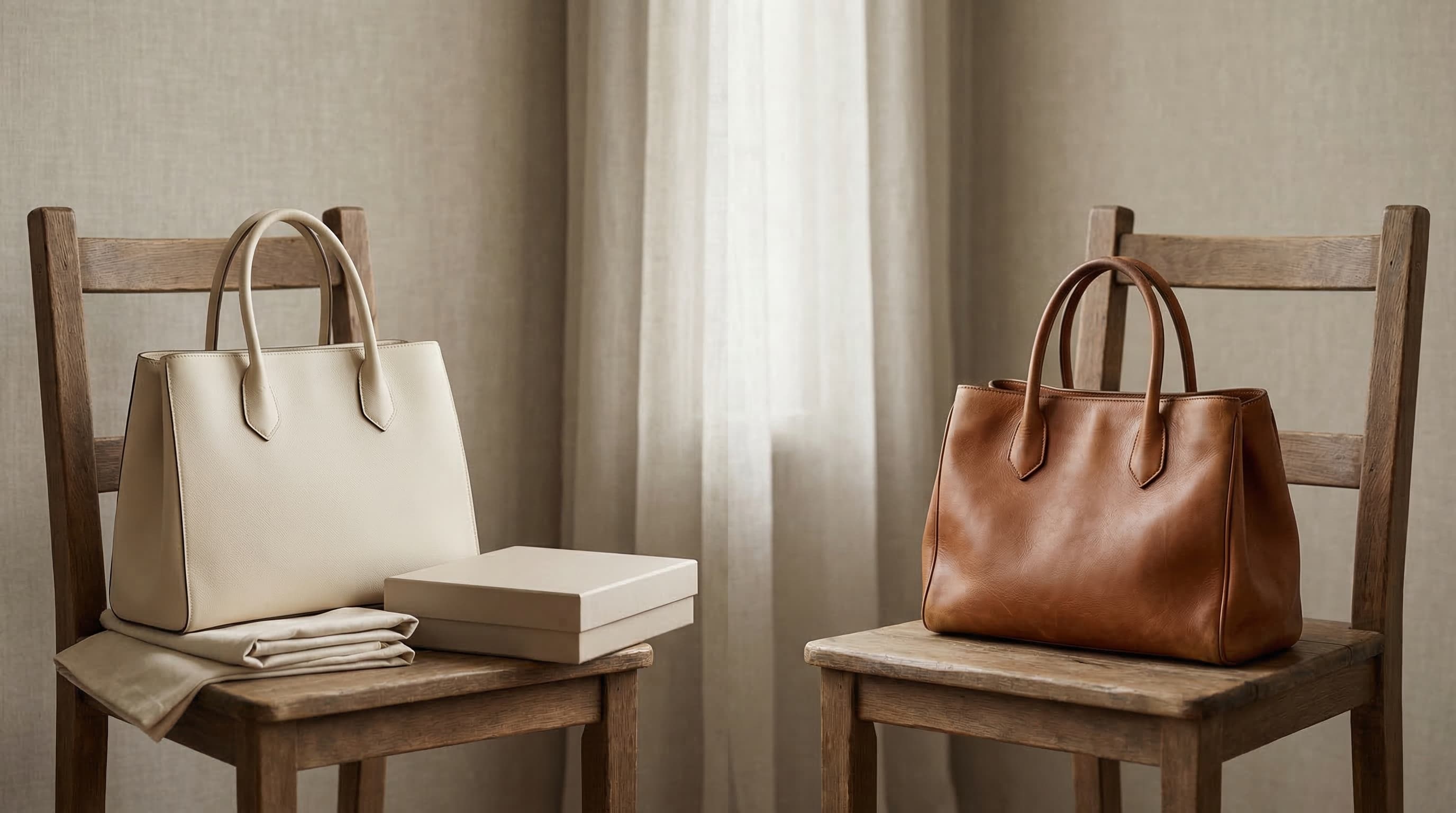
How to Authenticate a Hermès Garden Party Bag: 9 Checks (2026)
The Hermès Garden Party is the house's quiet tote: an open carryall introduced in 1964 that trades locks and flaps for volume, two rolled handles and a single central snap. It comes in two material families — an all-leather version in Negonda, the matte, large-grained calfskin associated with the line, and a toile canvas version reinforced with leather at the base, trim and handles — and it is lined in a chevron-pattern canvas over a leather base, with one interior zip pocket inside a single open compartment. The sides carry their own snaps, so the silhouette can sit cinched or open wider. That plainness is exactly what makes the bag worth checking carefully. There is no big logo and no hardware showpiece to compare; the verdict has to come from size class, material behaviour, saddle stitching, snap hardware, interior construction and the small stamped record Hermès presses into the leather. Copies usually photograph well as a tote shape, then separate in the hand: canvas that feels coated, leather grain that reads printed, stitches that run machine-straight, a snap with no weight, or a date letter framed for the wrong decade. Work the nine checks in order and let them vote together. For Hermès readers this sits alongside our Hermès Birkin guide, Hermès Kelly guide, Hermès Constance guide, Hermès Evelyne guide, Hermès Lindy guide and Hermès Picotin Lock guide: the family shares stitch and stamp discipline, then diverges in architecture.
Quick note: no single check proves a bag is real. Weigh all nine together, and always against the exact size and material the bag claims to be — a 30 in canvas, a 36 in Negonda and a 49 travel tote are related, not interchangeable.
Short answer
A genuine Garden Party is a 1964-lineage Hermès open tote in the size it is sold as — most commonly the 30 (roughly 30 × 22 × 13 cm), the 36 (roughly 36 × 26 × 17 cm) or the large 49 (roughly 49–50 cm wide) — built either in all-Negonda leather or in toile canvas with leather base, trim and rolled handles. It closes with a central Clou de Selle snap, carries a snap at each side so the ends can be cinched or released, and opens to one compartment lined in chevron canvas over a leather base with a single zip pocket. The leather parts should feel dense and matte with a natural large grain, the canvas should read as woven textile rather than print, the stitching should be tight, even and slightly diagonal in the house saddle tradition, the heat stamp should be crisp and composed, and the blind stamp's year letter and framing should agree with the bag's era and features. Asking price is never a check.
1. Model, Era and Size Class
Start by naming what the bag claims to be. The Garden Party line begins in 1964, so the model itself is old — but that does not make every old-looking tote plausible, because the size names and material pairings have their own history. The working family most buyers meet is the 30 (often called TPM), the 36 (often PM/MM in listings) and the 49 (GM, a travel-scale tote); a smaller Neo Garden branch has joined the family in recent years. Retailers do not all measure a soft tote the same way, and handle drop figures vary with how the bag is held, so judge by class rather than by a single millimetre.
Then measure the base, height and depth with the side snaps in the state the listing describes. A bag sold as a 30 that measures like a 36, or a 36 whose base belongs to the travel size, has a naming problem before it has an authenticity verdict. Proportions help as much as raw numbers: the Garden Party keeps the same open-tote architecture as it scales, so a size that grows in width but not in height or depth, or handles that sit at the wrong scale for the body, should slow you down.
Close with variant. All-leather Negonda, canvas with leather trim, and seasonal versions in other leathers, prints or special materials all exist, and each changes what Checks 3 and 4 should look for. A canvas bag judged by leather standards, or a leather bag excused from leather standards, is a category error — authenticate the bag against its own version first.
2. Silhouette, Handles and the Snapped Sides
The Garden Party's shape is a soft architecture: an open top, a flat leather-reinforced base, two rolled handles rising from leather straps, and ends that can be pulled in or let out. Set the bag down empty and then lightly filled. Empty, it should keep a settled tote profile rather than collapsing into a puddle or standing board-stiff; filled, the base should stay composed and the sides should flare or cinch evenly on both ends.
Read the handles closely, because they carry the bag's weight and its wear. Genuine rolled handles are evenly formed tubes of leather with consistent diameter, cleanly attached where the straps meet the body, and finished without loose ends or steps at the joins. Copies often show handles that are spongy, unevenly stuffed, or attached with stitching that wanders where the strap meets the panel. Uneven darkening or softening from real carrying is honest wear; asymmetry built into the handle itself is construction.
Then work the side snaps. Each end should release and re-fasten cleanly, and the silhouette change should be symmetrical — one side that refuses to sit where the other sits, or a side panel that buckles instead of folding, describes two standards of making on one bag. Honest wear can soften the ends; it should not reverse the geometry.
3. Materials: Negonda Leather and Toile Canvas
Name the material family before you touch it. On the all-leather version, Negonda is a matte calfskin with a visible, naturally varying grain, developed for this line's working-tote role: it should feel dense and dry rather than glossy, hold a soft structure, and show grain that continues naturally across panels instead of repeating like a print. Flex a discreet area gently — the surface should fold without crackling, whitening, or splitting into a coated shine, and the colour and finish should stay consistent between the outside and the underside of the same piece.
On the canvas version, the toile should behave like woven textile. Look at it at three distances. Across the room it reads calm and even. Up close, the weave structure should be visible as interlaced threads, not as a pattern printed onto a smooth coated surface. In the hand it should have textile body — flexible but substantial — and the leather base, trim and handles that reinforce it should meet the canvas with clean, even joins. Replica canvas usually gives itself away in material before pattern: limp or plasticky cloth, a printed grain where leather should be, or trim leather that feels thin beside the canvas it is meant to reinforce.
Smell and weight are supporting votes. Real leather and canvas smell like their materials; a strong chemical odour paired with feather weight and glossy folds is a combination worth walking away from. Equally, a pleasant hand never rescues failing stitching, snaps or stamps — the checks are designed to agree.
4. Stitching: The Saddle Discipline
Hermès stitching is the house's oldest signature, and the Garden Party — for all its casual brief — is held to it. The traditional saddle approach works two needles through the same holes, producing stitches that sit tight, even and at a consistent slight diagonal, with tension that stays regular around curves, corners and handle attachments. Count and compare where you can: runs on matching panels should agree with each other, and the work should look hand-guided in the right way — regular without being mechanically identical.
Copies tend to fail in one of two directions. Machine runs can look too straight, too flat and too perfectly spaced, with thread that sits on the surface rather than in it; careless runs wander, skip, or loosen at stress points such as handle bases and the leather base corners. Look hardest where the bag works hardest: where handles anchor, where the leather base meets the body, around the interior pocket, and along any trim-to-canvas join. A tote asks its seams to carry real loads, and genuine seams answer evenly.
Weigh repairs honestly. A professionally repaired stitch on an otherwise correct bag is a condition disclosure, not a verdict. What condemns is a stitch system that was never right — wrong angle, wrong thread character, or tension that changes from panel to panel.
5. Closure and Hardware: Clou de Selle and Side Snaps
The Garden Party's hardware is deliberately small, which makes its quality easier to feel. The central closure is a Clou de Selle snap — the saddle-nail form the house uses across its leather goods — and the side snaps share the same job at the ends. On a genuine bag the metal feels solid through the leather, the snap engages with a clean, positive catch, and it releases with controlled resistance rather than drifting open under the bag's own weight or needing to be forced.
Work each snap several times. Gritty travel, a catch that only holds at one angle, a cap that spins or sits crooked, or metal so light it feels hollow all vote against. So does mismatched hardware character on one bag — snaps that differ in tone, finish or weight from each other without a design reason. Genuine hardware is plated and finished evenly; surface wear from use can dull it, but peeling, flaking or a base-metal shine at the edges describes substitute metal.
Then check the marriage of hardware and leather. The snap components should sit centred in their leather surrounds, pressed and stitched without puckering, and the leather around them should not be split, stretched thin or repaired into place. A correct-looking snap mounted in failing leather has not passed — it has only located the failure precisely.
6. Interior: Chevron Lining, Leather Base and Zip Pocket
Turn the bag inside out in your inspection, because the interior is where a working tote tells the truth. The classic plan is one open compartment lined in chevron-pattern canvas, a leather base panel that gives the floor its structure, and a single zip pocket set into the lining. Seasonal and special versions can vary the lining print or pocket detail, so authenticate against the named version — but the standard of finish should not vary: lining fitted smoothly without sagging or bunching, seams clean, no glue residue or loose threads, and the leather base sitting flat and evenly joined.
Run the zip pocket as its own small bag. The zip should travel smoothly on even teeth, the pull should be properly finished and proportioned, and the pocket should be set straight in the lining with clean stitching at its corners — the points where sloppy work tears first. A pocket that is crooked, shallow beyond the version's pattern, or finished in a material a grade below the lining around it is an interior answer to an exterior question.
Weigh honest use correctly. A carried Garden Party interior can show marks, and canvas can record a life; what it should not show is substituted materials or construction shortcuts. Equally, a pristine interior cannot rescue a bag whose leather, canvas, stitching and snaps have already failed — it only earns its vote when the outside agrees.
7. The Heat Stamp: Typography and Placement
The house mark on a Garden Party is a pressed stamp, not a print: the Hermès Paris / Made in France wording impressed into the leather with clean letterforms, even spacing and a depth that reads as part of the material rather than sitting on top of it. Read it straight on and in raking light. A genuine impression holds up in both — letters composed as one balanced mark, neither crowded nor drifting, with no letter visibly heavier, lighter or differently shaped from its neighbours.
Copies tend to lose precision predictably. The stamp comes out shallow and blurred so letters fill in, or too deep and large so it looks machine-punched; the font drifts in a letterform's internal shape; the lines sit off-centre against the stitching or panel they belong to; or the wording is spaced like a label rather than composed like a stamp. Any misspelling or omitted origin line ends the discussion on its own.
Placement is corroboration, not trivia. The stamp should sit where the version puts it, at a sensible relationship to the seams and hardware around it, pressed straight rather than tilted or double-struck. A tidy stamp in the wrong place, or at the wrong scale for its panel, is still a failed check — and a perfect stamp never outvotes failing materials and stitching by itself.
8. The Blind Stamp: Year Letter, Framing and Honest Limits
Alongside the heat stamp, Hermès presses a blind stamp into the leather: a year letter together with craftsman characters identifying the maker. The part you can read publicly is the year, and the framing around that letter changed by era — unframed in the earliest period, circled through the middle decades, squared from the late 1990s to the mid-2010s, and unframed again on recent production, with the post-2015 letter sequence no longer running in simple alphabetical order. That gives you a consistency test: the letter and its frame must agree with each other, and both must agree with the bag's features, materials and hardware character for that period.
That test refuses in useful ways. A squared letter presented on a bag claimed as recent production, a circled letter on a version that did not exist in the circle era, or a letter whose year contradicts the lining, hardware or size branch in hand — each is a story that does not close. Read a worn stamp by its frame as carefully as by its letter, because a rubbed circle and a rubbed square point to different decades, and a guess here moves the answer by a generation.
Hold the limit firmly. The blind stamp is not a serial number you can look up: there is no public register that validates a code, the craftsman characters beside the year letter have no published key, and genuine stamps are copied onto fakes. The stamp's job is agreement — with the era, the version and the construction already established — and it is believed most when it refuses. Treat any seller who offers the stamp alone as proof as having answered a different question.
9. Stitching Finishes, Edges and Accompaniments
Finish where construction is hardest to hide: edges, ends and extras. Leather edges on the base, trim and handles should be evenly finished, with no fraying, bubbling finish or raw shiny cuts; canvas edges where they meet leather should be captured cleanly by the trim rather than escaping from it; and corners — especially the base corners that take the handling stress on a tote — should be built symmetrically, without one corner padded, pinched or rebuilt. Run the whole bag once with your eyes closed: a genuine tote feels like one standard of making from end to end.
Then weigh accompaniments in their proper place. A genuine dust bag is made of substantial canvas with the house name printed in the brand's disciplined style, sized plausibly for the bag it carries; care materials and receipts can support a story. But these are movable objects — bought, swapped and borrowed — so a correct dust bag beside failing stitching proves only that packaging travels between bags. A missing dust bag, equally, does not condemn a bag that passes Checks 1 to 8.
Bring the nine together: a size class that matches its name; a settled open-tote silhouette with even rolled handles and working side snaps; Negonda leather or toile canvas that behaves like the real material; tight, even, slightly diagonal saddle stitching; solid Clou de Selle hardware with a positive catch; a chevron-lined single compartment over a leather base with a cleanly set zip pocket; a crisp, composed heat stamp; a blind stamp whose letter and framing agree with the era; and clean edges with accompaniments as corroboration only. Never let the asking price stand in for any of those checks; price appears nowhere in these nine as a criterion.
At a glance: authentic vs. fake
| Check | Authentic Garden Party | Common copy |
|---|---|---|
| Model and size | 1964-lineage tote in its named class: 30 roughly 30 × 22 × 13 cm, 36 roughly 36 × 26 × 17 cm, 49 roughly 49–50 cm wide; proportions scale together | Size matching no class in the family; width grows without height or depth; handles at the wrong scale |
| Silhouette and handles | Settled open-tote profile, flat reinforced base, even rolled handles, symmetrical cinch at both snapped ends | Collapse or board stiffness; spongy uneven handles; one end buckling instead of folding |
| Materials | Matte Negonda with natural varying grain, or woven toile with textile body; leather trim meeting canvas cleanly | Printed grain, coated shine, crackling folds; limp plasticky canvas; thin trim leather |
| Stitching | Tight, even, consistently slight-diagonal saddle runs; matching panels agree; stress points reinforced | Machine-straight flat runs, or wandering skipped stitches; loose work at handle bases and base corners |
| Closure and hardware | Solid Clou de Selle centre snap and side snaps; clean positive catch; even plated finish matching across the bag | Hollow-feeling snaps, gritty or one-angle catches, crooked caps; peeling or mismatched hardware |
| Interior | Single compartment, chevron canvas lining fitted smoothly, leather base, one cleanly set zip pocket with a smooth zip | Sagging substitute lining, glue or loose threads, crooked shallow pocket, rough zip |
| Heat stamp | Crisp pressed lettering, balanced spacing, straight and correctly placed for the version | Blurred or over-deep stamp, drifting font, off-centre lines, misspelling or missing origin line |
| Blind stamp | Year letter and framing agree with each other and with the bag's era, materials and features | Frame from the wrong era, year contradicting the version, stamp offered as standalone proof |
| Finishes and extras | Even edges, symmetrical base corners, one standard of making throughout; dust bag and papers as corroboration | Frayed or bubbling edges, rebuilt corners; correct dust bag asked to rescue failing construction |
FAQ
When was the Hermès Garden Party introduced?
In 1964, which makes it one of the house's long-running tote designs rather than a seasonal style. That date is a boundary in both directions: the model cannot predate it, and a bag claimed as an early example still has to show the materials, hardware and stamp framing of its claimed period, not just an old-looking finish.
What size Garden Party should I buy?
The size it is sold as. The common classes are the 30 (roughly 30 cm wide), the 36 (roughly 36 × 26 × 17 cm) and the travel-scale 49, with a smaller Neo Garden branch in recent production. Soft totes measure differently between retailers and depending on filling and snap state, so judge by class and proportion — a bag between classes, or matching none, has a problem.
Is the Garden Party leather or canvas?
Both, and the distinction is a check, not a detail. The all-leather version uses Negonda, a matte large-grained calfskin; the canvas version pairs toile with leather base, trim and handles. Name the version first, then hold leather versions to leather standards — grain, hand and fold behaviour — and canvas versions to weave and trim standards.
Where is the date stamp on a Garden Party?
Pressed into the leather as a blind stamp: a year letter with craftsman characters beside it. The framing around the letter changed by era — squared on late-1990s to mid-2010s production, unframed on recent production — so read the frame with the letter. There is no public lookup that validates the code, and genuine stamps are copied, so treat it as an era-consistency check alongside materials and stitching, never as proof on its own.
Does a real Garden Party have a zip top?
The classic tote closes with a central Clou de Selle snap, with a further snap at each side to adjust the shape — it is an open tote, not a zip-top bag. Special and seasonal variants can differ, which is why Check 1 names the exact version first; a closure that does not belong to the named version is a finding, not a feature.
Sources
Public sources consulted for the facts summarised in our own words above; authentication judgments are this guide's synthesis.
- Madison Avenue Couture, Hermès Garden Party — 1964 introduction, all-Negonda and toile-with-leather versions, canvas lining, size family and Clou de Selle closure: https://madisonavenuecouture.com/products/hermes-garden-party-neo-23-vanille-toile-officier-canvas-and-etoupe-negonda-palladium-hardware
- FASHIONPHILE Academy, Hermes Garden Party Sizes — Neo Garden 23, 30 TPM, 36 MM and 49 GM classes with published dimensions, all-leather and canvas-leather branches: https://www.fashionphile.com/blogs/academy/hermes-garden-party-sizes
- FASHIONPHILE, Hermès Toile Negonda Garden Party Tote 36 listings — certified 36 examples: toile body, pebbled leather base and rolled handles, palladium snap, canvas interior with leather base, measured dimensions: https://www.fashionphile.com/products/hermes-toile-negonda-garden-party-tote-36-mm-black-1718607
- Sotheby's, Hermès Gold Negonda Garden Party 36, 2019 — certified example: 36 × 26 × 17 cm, chevron toile lining, interior zip pocket observations: https://www.sothebys.com/en/buy/_hermes-gold-negonda-garden-party-36-palladium-hardware-2019
- Madison Avenue Couture, How to Tell if a Hermès Bag Is Real or Fake — logo stamp composition, craft codes from 2015, leather and saddle-stitch indicators: https://madisonavenuecouture.com/blogs/news/how-to-tell-if-a-hermes-bag-is-real-or-fake
- LegitGrails, Hermès Authentication Service — blind stamp and date letter with framing eras, leather behaviour and saddle stitch count discipline: https://legitgrails.com/products/hermes-legit-check
- Yoogi's Closet, Hermes Authentication Guide & Serial Codes — blind stamp year table across unframed, circle and square eras, hardware plating notes: https://www.yoogiscloset.com/authenticate/hermes
- Bragmybag, Hermes Garden Party Bag — 1964 release, 30/36/49 size table and special-edition branches: https://www.bragmybag.com/hermes-garden-party-bag/
Related reading
How to Authenticate a Balenciaga City Bag · How to Authenticate a Balenciaga Hourglass Bag · How to Authenticate a Balenciaga Le Cagole Bag · How to Authenticate a Bottega Veneta Cassette Bag · How to Authenticate a Bottega Veneta Jodie Bag · How to Authenticate a Bottega Veneta Pouch Bag · How to Authenticate a Cartier Love Bracelet · How to Authenticate a Celine Luggage Bag · How to Authenticate a Celine Triomphe Bag · How to Authenticate a Chanel 19 Bag · How to Authenticate a Chanel 2.55 Reissue Bag · How to Authenticate a Chanel Boy Bag · How to Authenticate a Chanel Classic Flap Bag · How to Authenticate a Chanel Coco Handle Bag · How to Authenticate a Chanel Gabrielle Bag · How to Authenticate a Chanel Wallet on Chain · How to Authenticate a Dior Bobby Bag · How to Authenticate a Dior Book Tote · How to Authenticate a Dior Caro Bag · How to Authenticate a Dior Lady Dior Bag · How to Authenticate a Dior Saddle Bag · How to Authenticate a Fendi Baguette Bag · How to Authenticate a Fendi Peekaboo Bag · How to Authenticate a Givenchy Antigona Bag · How to Authenticate a Goyard Saint Louis Tote · How to Authenticate a Gucci Dionysus Bag · How to Authenticate a Gucci Horsebit 1955 Bag · How to Authenticate a Gucci Jackie 1961 Bag · How to Authenticate a Gucci Marmont Bag · How to Authenticate a Hermès Birkin Bag · How to Authenticate a Hermès Constance Bag · How to Authenticate a Hermès Evelyne Bag · How to Authenticate a Hermès Kelly Bag · How to Authenticate a Hermès Lindy Bag · How to Authenticate a Hermès Picotin Lock Bag · How to Authenticate a Loewe Puzzle Bag · How to Authenticate a Louis Vuitton Alma Bag · How to Authenticate a Louis Vuitton Capucines Bag · How to Authenticate a Louis Vuitton Multi Pochette Bag · How to Authenticate a Louis Vuitton Neverfull Bag · How to Authenticate a Louis Vuitton OnTheGo Bag · How to Authenticate a Louis Vuitton Pochette Métis Bag · How to Authenticate a Louis Vuitton Speedy Bag · How to Authenticate a Prada Cleo Bag · How to Authenticate a Prada Galleria Bag · How to Authenticate a Prada Re-Edition 2005 Bag · How to Authenticate a Saint Laurent Kate Bag · How to Authenticate a Saint Laurent Le 5 à 7 Bag · How to Authenticate a Saint Laurent Loulou Bag · How to Authenticate a Saint Laurent Manhattan Bag